5 Science-Backed Relaxation Techniques to Fall Asleep Faster on Sleepless Nights
Discover 5 science-backed relaxation techniques for sleepless nights: 4-7-8 breathing, progressive muscle relaxation, body scan meditation, and cognitive shuffle. Build a natural sleep routine that works.
Why Can't You Sleep?
Almost everyone has experienced a sleepless night. The causes of difficulty falling asleep are varied, but the most common is excessive activation of the sympathetic nervous system.
Balance of Sympathetic and Parasympathetic Nervous Systems
The human autonomic nervous system consists of two parts: sympathetic and parasympathetic. The sympathetic nervous system handles "fight mode," increasing heart rate, raising blood pressure, and maintaining wakefulness. The parasympathetic nervous system handles "relaxation mode," lowering heart rate, promoting digestion, and preparing for sleep.
In modern society, work stress, smartphone and computer use, and caffeine consumption make it easy for the sympathetic nervous system to remain dominant even at night. In this state, the body judges "it's not time to rest yet," making it difficult to fall asleep.
Effects of Smartphones and Blue Light
Particularly problematic is smartphone use before bed. Blue light emitted from smartphone screens suppresses secretion of melatonin, the sleep hormone. Melatonin normally increases after sunset, signaling to the body "night has come, it's time to sleep."
Blue light is a wavelength contained in sunlight, and the brain misidentifies it as "still daytime." As a result, melatonin secretion is suppressed and sleep is prevented. Ideally, refrain from using smartphones and computers from 2 hours before bedtime.
Thought Rumination and Stress
Have you experienced work matters or worries suddenly surfacing the moment you get into bed? This phenomenon called "thought rumination" occurs when problems you were too busy to think about during the day surface into consciousness during the quiet night.
This thought rumination further activates the sympathetic nervous system, increasing heart rate and maintaining wakefulness. Anxiety about "I must sleep" creates more stress, leading to a vicious cycle.
Effects of Caffeine and Alcohol
The half-life of caffeine (time for body concentration to halve) is about 5-6 hours. If you drink coffee at 3 PM, half the caffeine remains at 9 PM. People with high caffeine sensitivity are recommended to avoid caffeine intake after lunch.
While alcohol speeds up falling asleep, it significantly reduces sleep quality. Alcohol causes awakening in the latter half of sleep and decreases REM sleep (dream sleep). This results in morning fatigue and lethargy.
4-7-8 Breathing (Military-Adopted Relaxation Technique)
The 4-7-8 breathing method was developed by Dr. Andrew Weil, founder of the University of Arizona Center for Integrative Medicine. It's also adopted by the U.S. military for quickly transitioning from battlefield tension to relaxation.
Practice Method
- Completely exhale through your mouth (making a "whoosh" sound)
- Close your mouth and quietly inhale through your nose for 4 seconds
- Hold your breath for 7 seconds
- Completely exhale through your mouth for 8 seconds (making a "whoosh" sound)
- Repeat this 4 times
Why It's Effective
This breathing method's effectiveness is explained by several physiological mechanisms.
First, holding your breath temporarily increases blood carbon dioxide levels. This activates the parasympathetic nervous system, lowering heart rate and inducing relaxation.
Second, slow deep breathing moves the diaphragm significantly, stimulating the vagus nerve. The vagus nerve is the main nerve of the parasympathetic system, triggering relaxation responses.
Furthermore, focusing consciousness on counting breaths diverts attention from thought rumination, creating a mindfulness state. Concentrating on "how many more seconds" shifts awareness away from worries.
Practice Tips
Initially, holding breath for 7 seconds may be difficult. In that case, you can shorten the time while maintaining the ratio (e.g., 2-3.5-4 seconds). Gradually extend to the original 4-7-8 seconds as you become accustomed.
To feel effects, continuing for at least 2 weeks nightly before bed is recommended. As the body learns "this breathing method = sleep signal," you'll fall asleep more quickly.
Progressive Muscle Relaxation
Progressive Muscle Relaxation (PMR) was developed in the 1920s by American physician Edmund Jacobson. This technique creates deep relaxation by intentionally tensing then relaxing muscles.
Practice Method
Lie on your back in bed and tense then relax muscle groups in the following order. Tense each area for 5 seconds, then relax for 10 seconds.
- Bend right foot toes toward you, tensing the calf
- Tense right thigh muscles
- Repeat with left foot
- Tighten gluteal muscles
- Pull in abdomen
- Expand chest, tensing back muscles
- Make a fist with right hand, tensing forearm
- Tense entire right arm
- Repeat with left hand and arm
- Shrug shoulders toward ears
- Scrunch face (forehead, eyes, mouth)
- Release all body tension and breathe deeply
Why It's Effective
This technique's effectiveness is explained by "contrast effect." Intentionally tensing muscles makes the subsequent relaxed state more pronounced. The contrast between tension and relaxation helps the body recognize "truly relaxed."
Also, muscle tension activates the sympathetic nervous system, with subsequent relaxation making the parasympathetic dominant. Intentionally performing this switch balances the autonomic nervous system.
Furthermore, sequentially directing attention to each area diverts consciousness from thought rumination, enabling focus on physical sensations. This includes mindfulness elements, having an effect of detaching attention from anxiety and worries.
Practice Tips
When tensing, use moderate force that doesn't cause pain. Excessive force can injure muscles.
Consciously perceive the relaxation moment. Focus attention on the "loosening sensation" when releasing force.
After completing the full body circuit, repeating once more is more effective. The second time makes entering deeper relaxation easier.
Body Scan Meditation
Body scan meditation is a type of mindfulness meditation that sequentially directs awareness to each body part. It's a core practice of Mindfulness-Based Stress Reduction (MBSR) developed by Dr. Jon Kabat-Zinn at the University of Massachusetts.
Practice Method
Lie on your back in bed and close your eyes. Direct awareness to each area in the following sequence. Without judgment or evaluation, simply observe sensations.
- Direct awareness to breathing. Feel chest and abdomen movement
- Direct awareness to left foot toes. Feel temperature, pressure, texture
- Move awareness to left foot sole, ankle, calf, knee, thigh
- Repeat with right foot
- Move awareness to pelvis, buttocks, waist, abdomen
- Progress to chest, back, shoulders
- Starting from left fingertips, progress through palm, wrist, forearm, elbow, upper arm, shoulder
- Repeat with right hand
- Move awareness to neck, jaw, mouth, nose, cheeks, eyes, forehead, crown
- Finally feel the whole body at once, relaxing with breathing
Why It's Effective
Body scan meditation works through "attention redirection." It pulls consciousness trapped in thought rumination and worries back to the "here and now" reality of physical sensations.
Neuroscience research shows mindfulness meditation decreases activity in the amygdala (brain region processing fear and anxiety). It also increases prefrontal cortex activity (responsible for rational thought), improving emotional regulation ability.
Furthermore, directing awareness to each body part enables noticing and naturally releasing unconsciously accumulated muscle tension. Many people aren't aware of how much they're tensing their bodies.
Practice Tips
Initially, one circuit from feet to head may take 15-20 minutes. Falling asleep midway is fine. In fact, that's the goal.
No need to linger long on each part. A few seconds each is sufficient. What's important is continuously moving awareness.
If thoughts arise, don't reject them — just notice and return awareness to physical sensations. The attitude of accepting "thoughts arising is natural" is important.
Cognitive Shuffle (Developed by Canadian Psychologist)
Cognitive Shuffle was developed by Dr. Luc Beaudoin, a cognitive scientist at Simon Fraser University in Canada. This technique induces "sleep mode" in the brain by randomly switching thoughts.
Practice Method
- Think of one simple word (e.g., BEDTIME)
- Think of words starting with the first letter (B) and imagine their images
- Banana → Imagine a yellow banana
- Book → Imagine books lined on a shelf
- Bird → Imagine a bird flying in the sky
- When you can't think of more B words, move to the next letter (E)
- After finishing all letters in the word, repeat with another word
Why It's Effective
This technique's effectiveness is explained by the psychological process of "cognitive defusion." Successively imagining random, unrelated images moves the brain away from logical thinking or problem-solving mode.
Sleep research shows pre-sleep brain activity transitions to a state where short dream-like images called "microsleep" fragmentarily surface. Cognitive shuffle intentionally mimics this natural sleep onset process.
The brain interprets the state of successively surfacing unrelated images as "logical thinking is no longer needed, let's prepare for sleep." This naturally promotes sleep onset.
Also, focusing consciousness on random images diverts attention from worries and thought rumination. Shifting awareness from the specific worry of "tomorrow's presentation" to random images like "banana," "book," "bird" reduces stress response.
Practice Tips
It's important to imagine images as specifically and visually as possible. Choose things or creatures actually visible, not abstract concepts.
After imaging each for a few seconds, immediately move to the next. Lingering on one image causes thinking about it, returning to logical thinking mode.
The same or related words continuing is fine. What's important is continuing to "shuffle" thoughts.
There's also an app version of this technique called "mySleepButton" for practicing with voice guidance.
Designing Pre-Sleep Routines
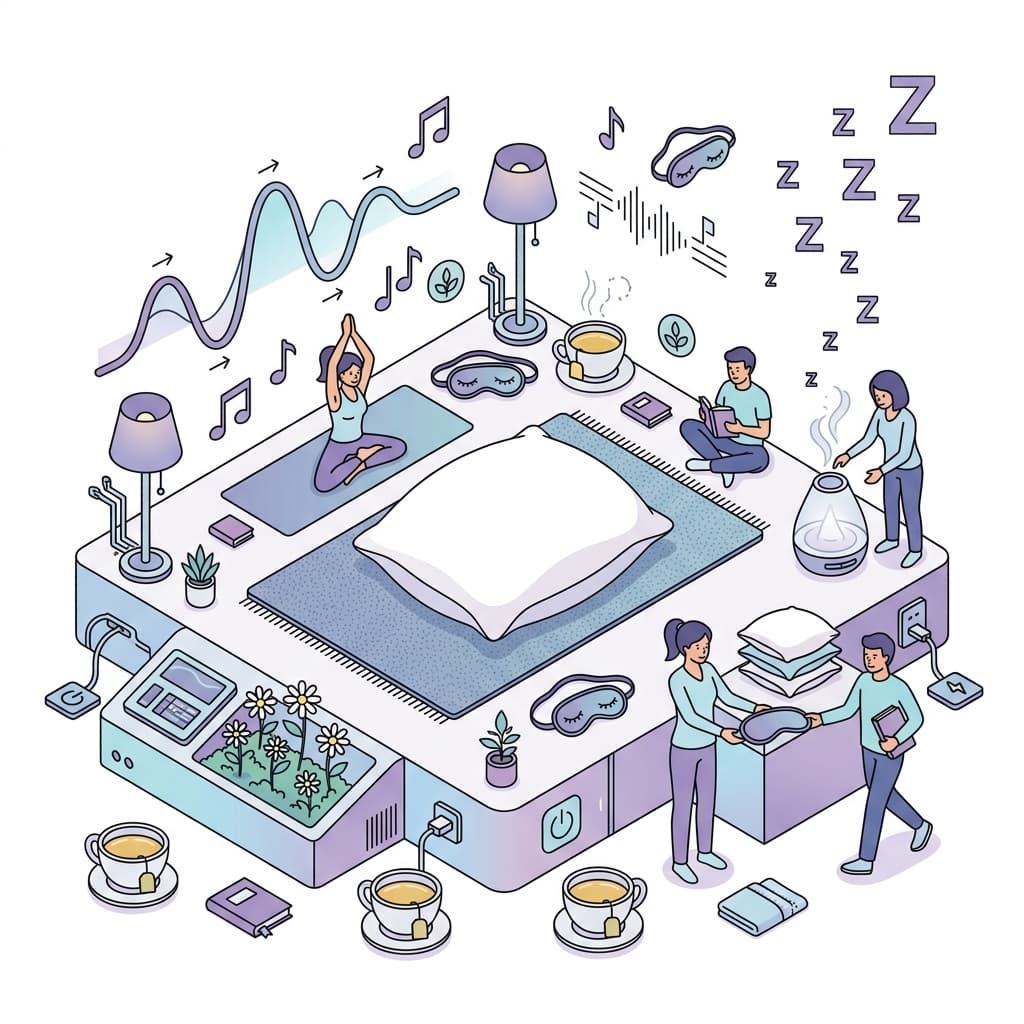
The above techniques are even more effective when combined with proper pre-sleep routines. Consciously transitioning to relaxation mode from 2 hours before bedtime is ideal.
What You Can Do 2 Hours Before Bed
Limit Screen Time
Refrain from using smartphones, tablets, computers, and TV. If use is necessary, enable night mode (blue light cut function) and minimize screen brightness.
Dim Lighting
Strong lighting promotes wakefulness. From 2 hours before bedtime, switch to warm-colored indirect lighting. Orange or red light is said to less inhibit melatonin secretion.
Light Stretching or Yoga
While vigorous exercise is counterproductive, light stretching or yoga loosens muscle tension and activates the parasympathetic nervous system. Particularly, forward bends and supine poses have high relaxation effects.
Warm Drinks
Caffeine-free herbal teas (chamomile, lavender, valerian) or warmed milk warm the body and promote relaxation. However, excessive drinking causes nighttime bathroom trips, so keep to moderate amounts.
Bathing
Soaking in a lukewarm bath at 38-40°C for 15-20 minutes 1-2 hours before bedtime raises core body temperature. Sleepiness arrives as temperature drops afterward. Baths that are too hot stimulate the sympathetic nervous system and are counterproductive.
Journaling
Writing worries and tomorrow's tasks on paper reduces thought rumination. "Externalizing from the mind" makes the brain judge "no need to remember anymore."
Bedroom Environment Optimization
- Temperature: 16-19°C is ideal (slightly cool feeling)
- Humidity: 50-60%
- Lighting: Completely dark, or if necessary, weak red light
- Sound: As quiet as possible. If noise unavoidable, use white noise or earplugs
- Bedding: Choose mattress and pillow suited to your body
Using the Sleep Calculator Tool
Setting appropriate sleep duration and wake time is also important for improving sleep quality.
Sleep CalculatorWhat time should I sleep? Calculate your 90-minute sleep cycles to wake up refreshed.This tool calculates optimal bedtime by working backward from wake time. Sleep cycles are approximately 90 minutes (1.5 hours), repeating REM and non-REM sleep. Waking at cycle breaks provides refreshing awakening.
For example, if you need to wake at 7 AM, ideal bedtimes are 11:30 PM or 10:00 PM (4.5 or 6 cycles). Use this tool to design a sleep schedule matching your lifestyle rhythm.
Summary
Try science-backed relaxation techniques on sleepless nights. The 4-7-8 breathing method quickly activates the parasympathetic nervous system, progressive muscle relaxation loosens muscle tension, body scan meditation diverts consciousness from thought rumination, and cognitive shuffle induces sleep mode in the brain.
These techniques are even more effective when combined with pre-sleep routines. Incorporate screen time limits, lighting adjustments, light exercise, warm drinks, bathing, and journaling to prepare body and mind for sleep.
Also, using the sleep calculator tool to set bedtime and wake time matching your sleep cycles achieves higher quality sleep.
Sleep is the foundation of health. Master appropriate techniques and routines to gain comfortable nights and refreshing mornings.
Disclaimer
This article is intended to provide general sleep improvement information and does not substitute for medical diagnosis or treatment. If chronic insomnia, sleep apnea syndrome, or other sleep disorders are suspected, please visit a medical institution. If symptoms don't improve or worsen after practicing techniques in this article, promptly consulting a physician is recommended. Depending on individual health conditions, specific techniques may not be suitable.