Early Signs of Burnout and What You Can Do Right Now to Prevent and Recover
Hating work or losing all motivation are early burnout signs. Using WHO's 3 symptoms and Freudenberger's 12-stage model, learn to objectively assess your state and start preventive steps today.
What is Burnout: WHO Classification as "Occupational Phenomenon," Not a Disease
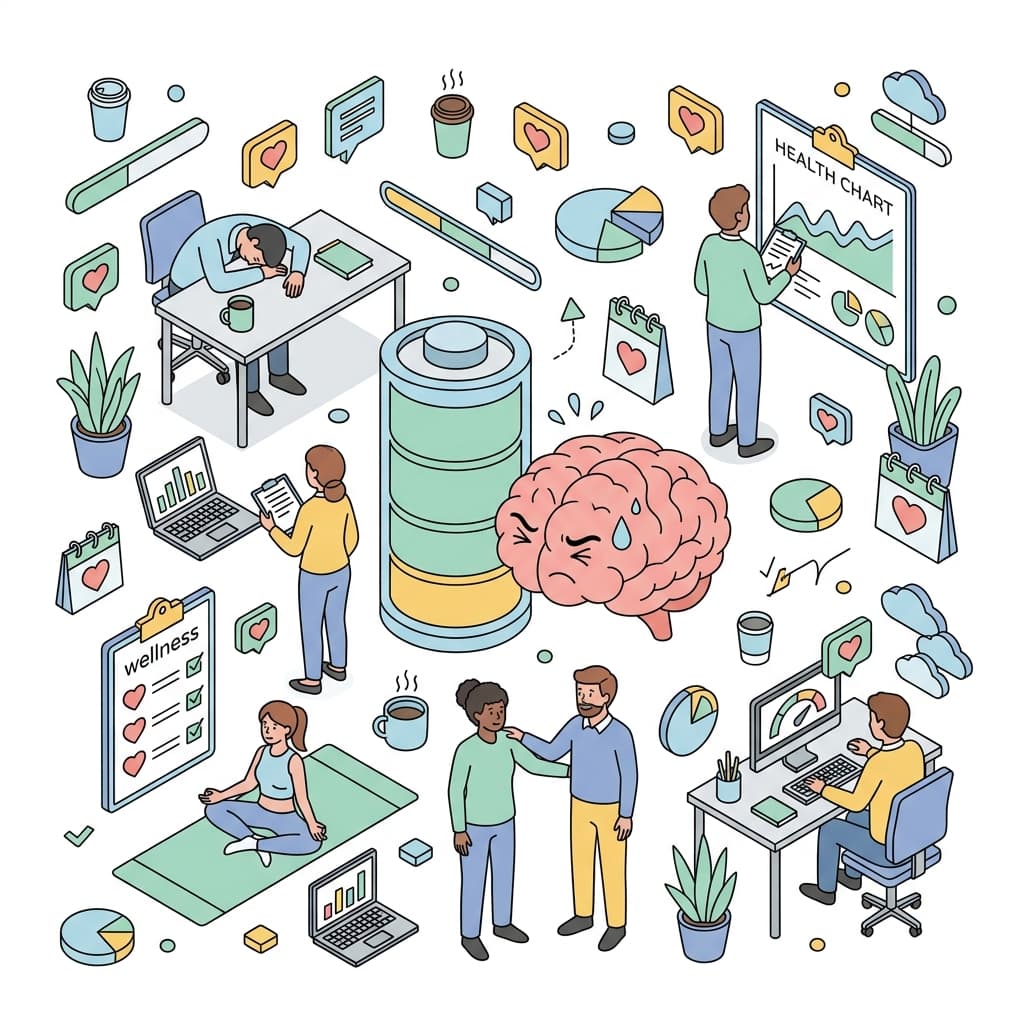
Burnout syndrome refers to a state of mental and physical energy depletion caused by prolonged chronic workplace stress.
In 2019, the World Health Organization (WHO) classified burnout in ICD-11 as an "occupational phenomenon"—not a medical condition, but a problem stemming from workplace environment and work practices.
This means burnout is internationally recognized as a phenomenon caused by structural workplace factors, not individual weakness or mental fragility.
Professions Most at Risk
The following occupations and environments have particularly high burnout risk:
- Healthcare workers (doctors, nurses)
- Teachers
- Social workers, welfare professionals
- Customer support and service workers
- IT engineers (long hours, deadline pressure)
- Entrepreneurs and executives (weight of responsibility)
Helping professions, creative roles, and high-responsibility jobs carry higher burnout risk.
Three Core Symptoms of Burnout: Exhaustion, Cynicism, Inefficacy
WHO defines burnout across three dimensions:
1. Emotional Exhaustion
Extreme fatigue to the point of feeling "I can't do anything anymore." Rest doesn't help, and even getting up in the morning feels depressing.
Specific symptoms:
- Chronic fatigue
- Unable to get up or go to work
- Palpitations and nausea when thinking about work
- Exhaustion doesn't lift even on weekends
2. Depersonalization / Cynicism
Becoming cold and indifferent toward work, colleagues, and clients. What once inspired passion now feels like "who cares."
Specific symptoms:
- Treating clients or patients as objects
- Loss of empathy for colleagues
- Losing sense of work's meaning, becoming cynical
- Avoiding interaction with others
3. Reduced Personal Accomplishment
Dominated by feelings of "I'm incompetent" and "nothing I do matters." Feeling unable to do work you used to handle.
Specific symptoms:
- Loss of self-efficacy
- Unable to feel satisfied with work results
- Uncontrollable self-blame
- Unable to hope for the future
When all three symptoms align, burnout is highly likely.
12 Stages Leading to Burnout (Freudenberger Model)
American psychologist Herbert Freudenberger outlined 12 stages in the burnout process:
Stage 1: Compulsion to Prove Oneself
Intense anxiety about "I must prove my worth." Common in new hires or recent promotions.
Stage 2: Intensified Effort
Overworking to meet expectations. Overtime and weekend work become routine.
Stage 3: Neglecting Other Needs
Everything outside work (hobbies, friends, family, sleep, meals) takes a back seat.
Stage 4: Denial of Conflict
Insisting "I'm not tired" and "I'm fine" while continuing to push beyond limits.
Stage 5: Distortion of Values
Work becomes everything; other values are looked down upon.
Stage 6: Denial of Problems and Aggression
Health issues and interpersonal troubles begin, but causes are denied and others are blamed.
Stage 7: Withdrawal
Social engagement is avoided; isolation begins.
Stage 8: Obvious Behavioral Changes
Changes visible to others. Tardiness and absences increase.
Stage 9: Loss of Self
"I don't know who I am anymore." Emotions go numb.
Stage 10: Inner Emptiness
A gaping void in the heart. Attempts to fill it with alcohol or overeating.
Stage 11: Depression Symptoms
Feelings of depression, despair, and suicidal ideation—approaching clinical depression.
Stage 12: Complete Burnout
Complete mental and physical collapse. Hospitalization or long-term leave required.
Stages 4–6 are "early warning yellow lights." Stage 7 onward requires professional intervention.
Difference Between Burnout and Depression
Burnout and depression show similar symptoms but differ in mechanism and scope.
| Aspect | Burnout | Depression |
|---|---|---|
| Cause | Workplace stress specific | Diverse (genetic, environmental, personality) |
| Scope | Primarily work-related | Affects all areas of life |
| Recovery | Improves with environment change | May require therapy and medication |
| Classification | Occupational phenomenon (WHO) | Mental disorder |
However, untreated burnout often transitions into clinical depression. The boundary is blurry. Stages 11–12 require psychiatric or psychosomatic care.
Stress CheckerEvaluate your current mental stress levels with a quick questionnaire.Self-Check Methods and Early Detection Points
To know if you're approaching burnout, answer the following questions.
Simple Burnout Checklist
If 5 or more have continued for over 2 weeks, caution is warranted.
- Hard to wake up in the morning; don't want to go to work
- Anxiety or palpitations when thinking about work
- Work that was once enjoyable now feels painful
- Increased irritation toward colleagues or clients
- Can't recover on weekends; no motivation to do anything
- Poor concentration; mistakes increasing
- Lost interest in hobbies and socializing with friends
- Loss of appetite or overeating
- Trouble falling asleep or waking during the night
- Increasing feelings of "I'm incompetent"
- Unable to feel hopeful about the future
- Increased alcohol or caffeine intake
3–4 matches: Mild stress. Take early action. 5–7 matches: Early-stage burnout. Consider consulting a professional. 8+ matches: Serious burnout. Medical consultation recommended.
Workplace and Individual Risk Factors
Burnout is not an individual issue—workplace factors play a major role.
Workplace Risk Factors
- Excessive workload and long hours
- Lack of autonomy (can't make decisions)
- Unfair evaluation and compensation
- Lack of community (isolation)
- Value misalignment (company policies vs. personal beliefs)
- Role ambiguity or role conflict
Individual Risk Factors
- Perfectionism
- Excessive sense of responsibility for others
- Self-sacrificing personality
- Unable to say no
- Strong need for approval
When workplace and individual factors overlap, burnout risk is maximized.
Concrete Steps for Recovery
Recovering from burnout requires both environmental improvement and self-care.
Step 1: Acknowledge Your Condition
Stop denying with "I'm fine." Admit you're exhausted. This is the first step to recovery.
Step 2: Prioritize Rest
- Take paid leave (without guilt)
- Consider medical leave (if serious)
- Ensure sleep time (minimum 7 hours)
Step 3: Set Boundaries
- Decide on maximum overtime hours
- Don't check email outside work hours
- Practice saying "no" to unreasonable requests
Step 4: Digital Detox
- No smartphone/PC 1 hour before bed
- Limit SNS usage time
- Turn off notifications
Step 5: Review Workload
- Discuss workload with supervisor
- Reset task priorities
- Negotiate to eliminate unnecessary work
Step 6: Seek Support
- Consult occupational physician or counselor
- Talk to trusted friends or family
- Visit psychiatrist or psychosomatic clinic (as needed)
Step 7: Reconfirm Your Values
- Remember "why I chose this job"
- Reevaluate roles outside work (parent, friend, hobbyist)
- Consider career transition
Recovery can take months to over a year. Don't rush; start with small steps.
Regular Monitoring with the Stress Check Tool
Burnout doesn't strike suddenly—it progresses gradually. That's why regular self-checks are crucial.
Using a stress check tool, you can visualize your current stress state in minutes. Checking monthly and recording score trends helps catch early signs of deterioration.
Check Frequency Guidelines
- Monthly: Normal monitoring
- Weekly: During busy periods or projects
- Daily: If symptoms are already present
If scores worsen for 3 consecutive months, professional consultation is strongly recommended.
Summary: Burnout is Preventable
Burnout is not individual weakness—it's a workplace environment and work style issue.
- WHO definition: Emotional exhaustion, depersonalization, reduced accomplishment
- Progresses through 12 stages (stages 4–6 are early intervention opportunities)
- Different from depression, but can transition if ignored
- Recovery requires rest, boundary-setting, and support
Continuing to push with "just a bit more effort" leads to stage 12 complete collapse. Notice early and have the courage to rest. That's the wisest choice.
Work is part of life, not all of it. Prioritize protecting yourself.
Disclaimer
This article is for general informational purposes only and is not a substitute for medical diagnosis or treatment. If burnout symptoms are severe, or if other mental health conditions such as depression are suspected, please consult a psychiatrist or psychosomatic clinic. For workplace responses, we recommend consulting occupational physicians, HR departments, labor unions, or other specialized institutions.