Are Morning and Evening Types Genetic? The Science of Chronotypes and Circadian Rhythms
Night owls aren't lazy — they may be genetically wired that way. Explore the science of chronotypes, PER3 and CLOCK gene variants, and how understanding your circadian biology can optimize your daily schedule.
"Not a Morning Person" Is Biology, Not Laziness
The narrative that early risers are more productive and disciplined is pervasive — but chronobiology research tells a different story. Whether you're a morning or evening person is substantially determined by your genes and circadian clock, not your work ethic.
The Circadian Clock
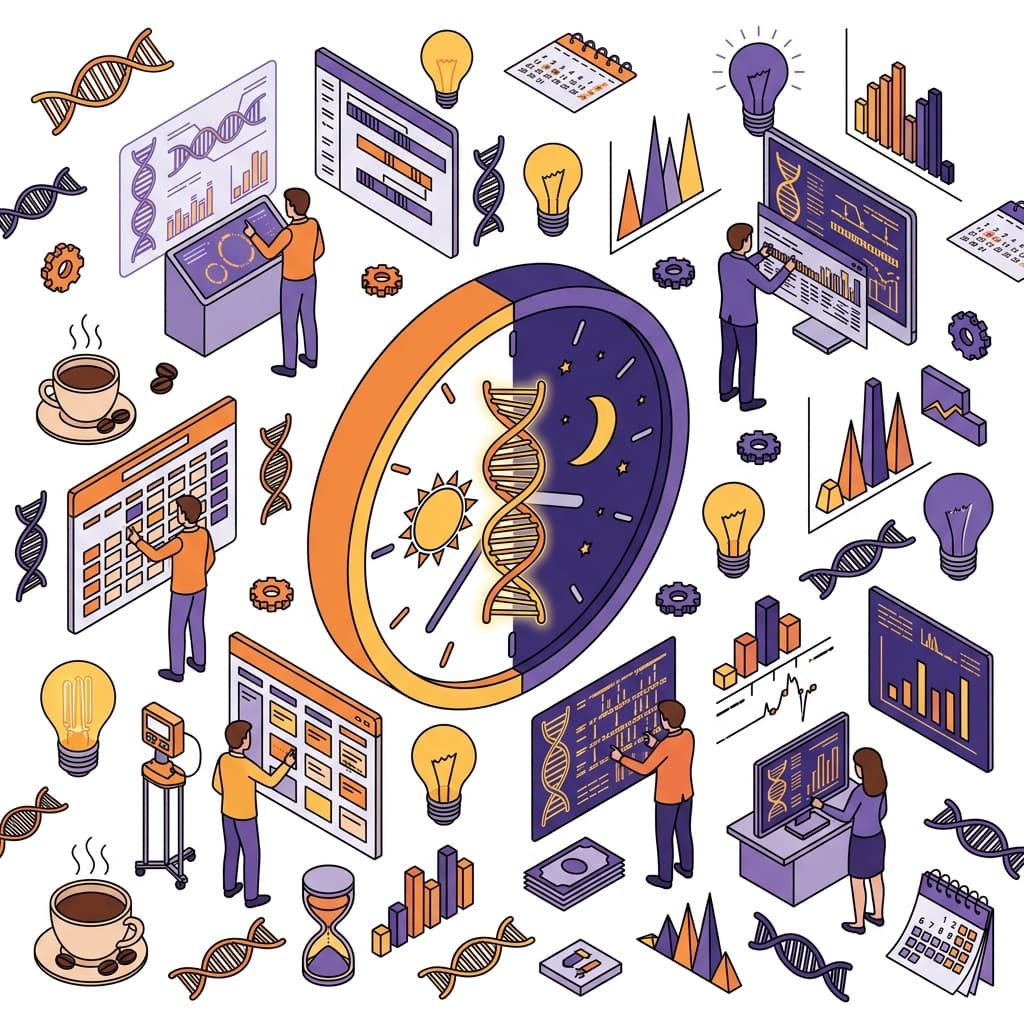
The human circadian rhythm runs on an approximately 24.2-hour cycle (not exactly 24 hours). Its master clock — the Suprachiasmatic Nucleus (SCN) in the hypothalamus — coordinates sleep-wake cycles, body temperature, hormone secretion, digestion, and immune function.
Light is the primary zeitgeber (time cue): Light entering the retina signals the SCN to reset the clock, synchronizing internal biology with the external day.
What Is a Chronotype?
Chronotype describes an individual's innate circadian timing preference — often simplified as "morning type (larks)" vs. "evening type (owls)." In reality, it exists on a continuous spectrum.
Research by chronobiologist Till Roenneberg (Munich) found roughly:
- Morning types (~16%): Naturally early to bed, early to rise
- Intermediate types (~68%): Adaptable to various schedules
- Evening types (~16%): Naturally late to bed, late to rise
Genetic Basis of Chronotype
PER3 Gene (Period 3)
The PER3 gene is a core clock gene regulating circadian periodicity. Two variants exist:
- PER3⁵/⁵ (longer variant): Associated with morning preference and higher sensitivity to sleep deprivation
- PER3⁴/⁴ (shorter variant): Associated with evening preference and somewhat better tolerance for sleep loss
CLOCK Gene
The CLOCK gene is the master switch controlling basic circadian period. Specific polymorphisms (e.g., T3111C) are associated with evening chronotype in research studies.
Heritability
Chronotype is approximately 50% heritable. The remaining variation comes from age, lifestyle, and light environment.
Chronotype shifts across the lifespan:
- Children: morning-oriented
- Teens/early 20s: maximum evening shift (puberty-related)
- 30s onward: gradual morning shift
- Elderly: strongest morning preference
Social Jetlag: The Hidden Health Risk
When evening types are forced to follow morning-oriented social schedules (9-to-5 work, early school start times), they experience social jetlag — a mismatch between biological sleep timing and social obligations.
Chronic social jetlag correlates with:
- Persistent sleep deficiency and impaired concentration
- Higher rates of obesity
- Increased cardiovascular disease risk
- Greater prevalence of depression and anxiety
Optimal Daily Schedules by Chronotype
Morning Type
- 6:00 AM: Wake, get natural light exposure
- 7:00–10:00 AM: Peak cognitive performance (deep work, critical decisions)
- 1:00–4:00 PM: Lower alertness (routine tasks, administrative work)
- 10:00 PM: Bed
Evening Type
- 8:30–9:00 AM: Wake (latest manageable)
- 9:00–11:00 AM: Warm-up period (emails, routine tasks)
- 11:00 AM–2:00 PM: Rising cognitive performance
- 3:00–8:00 PM: Peak performance window
- Midnight–1:00 AM: Sleep
Shifting an Evening Chronotype Earlier
If you need to function on morning schedules, evidence-based approaches for gradual circadian advancement:
- Consistent wake time — same time every day, including weekends (light timing resets the clock)
- Bright morning light exposure — outdoor daylight or a 10,000-lux light therapy lamp
- Gradual bedtime advancement — shift 15–30 minutes earlier per week, not all at once
- Blue light elimination 3 hours before bed
- Low-dose melatonin (0.5mg, 2–3 hours before target bedtime) — consult a doctor
However: completely converting a genetic evening type to morning type is biologically difficult. Working with your chronotype via flexible scheduling is more sustainable than fighting it.
FAQ
Q: Do evening types sleep worse? A: Not inherently. Sleep quality problems arise from mismatch — when an evening type is forced to wake at 6 AM. Given appropriate timing, evening type sleep quality equals morning types.
Q: Can genetic testing reveal my chronotype? A: Some consumer genetics services test PER3/CLOCK variants. However, these indicate tendencies, not absolutes. The Munich Chronotype Questionnaire (MCTQ) is the validated behavioral assessment tool used in research.
Q: Can remote workers benefit from chronotype alignment? A: Yes — significantly. Studies show evening types working flexible hours report higher productivity and wellbeing than those forced onto rigid morning schedules.
Conclusion
- Morning vs. evening preference is ~50% genetic, primarily influenced by PER3 and CLOCK gene variants
- The circadian clock runs on ~24.2-hour cycles, calibrated by light
- Forcing evening types onto morning schedules creates social jetlag with measurable health consequences
- The most sustainable approach: know your chronotype and design your schedule accordingly
Related Articles