How to Calculate Daily Calories Correctly: Why You Might Not Be Losing Weight as Expected
Expert guide on calculating Total Daily Energy Expenditure (TDEE) and common pitfalls in calorie estimation. Learn the truth about physical activity levels and how to achieve consistent weight loss results.
Introduction: Solving the Mystery of "No Weight Loss Despite Counting"
When starting a diet, many people begin by calculating their calories. If an online simulator says your "daily calorie expenditure is 2,000 kcal," it's natural to think that restricting intake to 1,500 kcal will guarantee weight loss.
However, reality is rarely that simple. Many people struggle with thoughts like, "calculated a deficit, but my weight won't budge," or "I'm actually gaining weight."
In this article, we will delve into the most frequently overlooked pitfalls in calculating Total Daily Energy Expenditure (TDEE) and provide an accurate, science-based calculation guide.
1. Understanding the Breakdown of TDEE
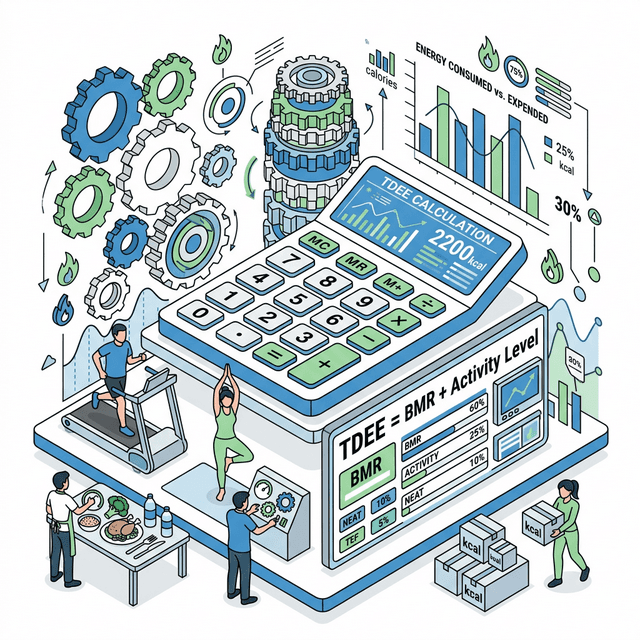
The energy we consume in a day consists of three primary components:
- Basal Metabolic Rate (BMR): Approx. 60–70%
- Diet Induced Thermogenesis (DIT): Approx. 10%
- Thermic Effect of Activity (TEA): Approx. 20–30%
The Importance of BMR
BMR is the energy required just to stay alive—for breathing, heartbeat, and organ function. It depends heavily on age, gender, height, weight, and most importantly, muscle mass.
The Truth About TEA
TEA includes not just exercise but also daily movements (NEAT: Non-Exercise Activity Thermogenesis), such as housework, commuting, and walking. Surprisingly, standing all day at work can often contribute more to your daily expenditure than a one-hour gym session.
Daily Calorie CalculatorFind your Total Daily Energy Expenditure (TDEE) based on your activity level.2. The Biggest Pitfall: Overestimating Physical Activity Level (PAL)
The most common mistake when calculating TDEE is overestimating one's activity level.
Most calculators categorize activity as follows:
- Level 1 (Sedentary): Desk work, little to no exercise.
- Level 2 (Moderately Active): Commuting, housework, or light sports 1–2 times a week.
- Level 3 (Very Active): Standing job or intense sports 3–5 times a week.
"Moderate" is Often Actually "Sedentary"
In modern society, if you work at a desk and commute by car or train, you are likely scientifically classified as "Level 1 (Sedentary)," even if you hit the gym once a week.
Calculating your calories as "Level 2" because you jog twice a week often results in an overestimate of 200–300 kcal per day. This is the primary reason why many fail to lose weight despite a theoretical deficit.
3. The Pitfall Calculators Don't Show: Adaptive Thermogenesis
Another pitfall is our body's amazing capacity to adapt.
Survival Mode: Saving Energy
When you restrict calories drastically for a long period, your body perceives a "famine" and lowers its metabolism to conserve energy. This is called "Adaptive Thermogenesis."
A calculator assumes that if you burned 2,000 kcal last year, you will burn 2,000 kcal this year. However, if you have been dieting for several months, your body becomes more efficient, and your actual expenditure may be 10–15% lower than the calculated value.
4. Three Steps to Mastering Accuracy
How do you find your true caloric expenditure?
Step 1: Start with Conservative Numbers
Don't trust the first result you see. Set your activity level one step lower than you think it is.
Step 2: Track a 2-Week Average
Record your weight trends, calorie intake, and "daily steps" for two weeks.
- If your weight stays the same while following the calculated calories, that is your "True Maintenance Calorie."
Step 3: Quantify Activity with Step Count
Instead of subjective feelings, use step counts to determine your PAL:
- Under 5,000 steps: Sedentary (PAL 1.2–1.4)
- 5,000–10,000 steps: Moderate (PAL 1.5–1.7)
- Over 10,000 steps: Active (PAL 1.8+)
5. Strategy to Increase Burn Efficiently: Maximize NEAT
While intense exercise (EAT) is great, the strategic key to diet success is maximizing NEAT (Non-Exercise Activity Thermogenesis).
- Take the stairs instead of the escalator.
- Walk while talking on the phone.
- Stand up every 30 minutes.
- Do quick cleaning or tidying up.
Each of these is a small burn, but they can add up to over 300 kcal per day. Running off 300 kcal takes over 30 minutes of jogging, yet you can achieve the same effect just by changing your daily habits.
FAQ: Frequently Asked Questions
Q1. Will increasing muscle mass dramatically increase my burn?
A1. Muscle mass contributes about 13 kcal per kg per day to BMR. While this sounds small, having more muscle increases your metabolic rate during activity, which is vital for long-term health.
Q2. Should I burn the exact same amount of calories every day?
A2. Activity levels fluctuate. If you are sedentary on weekdays but outdoorsy on weekends, it's better to focus on your weekly average energy balance.
Q3. Should I trust an activity tracker or an online calculator?
A3. Activity trackers (like Apple Watch or FitBit) measure your "actual movement," making them generally more reliable than static calculators. However, neither is perfect. Use them as a baseline and adjust based on "weight trends."
Summary: Calculation is Just the Starting Line
A calorie calculator is a fantastic compass to start your journey. But never forget that the result is an "estimate."
The key is to use the calculation as a base and refine it based on changes in your physique and lifestyle.
Start by using Jenee's calculator to get an objective view of your current state.
Daily Calorie CalculatorFind your Total Daily Energy Expenditure (TDEE) based on your activity level.