Optimal Calorie Guide by Body Type and Age: How to Find the Perfect Intake for You
Calorie needs change drastically based on age and body composition. This guide explores physiological shifts from your 20s to 50s+ and offers scientific methods to customize your intake based on your unique body type.
Introduction: Are You Settling for "Average" Calorie Standards?
General guidelines like "the average 30-year-old woman needs 2,000 kcal" are just averages. In reality, even two people of the same age and height can have optimal caloric intakes that differ by hundreds of calories depending on their body composition, past dieting history, and metabolic health.
Sticking to an ill-fitting calorie goal doesn't just stall progress—it increases the risk of muscle loss, rebound, and long-term metabolic damage.
In this guide, we dive deep into physiological changes across aging and provide the expertise needed to find your "personalized calorie code" based on your unique body type.
1. The Real Reason Why Expenditure Drops with Age
The common saying "I could eat anything in my 20s" has scientific backing.
The Correlation Between Aging and Metabolism
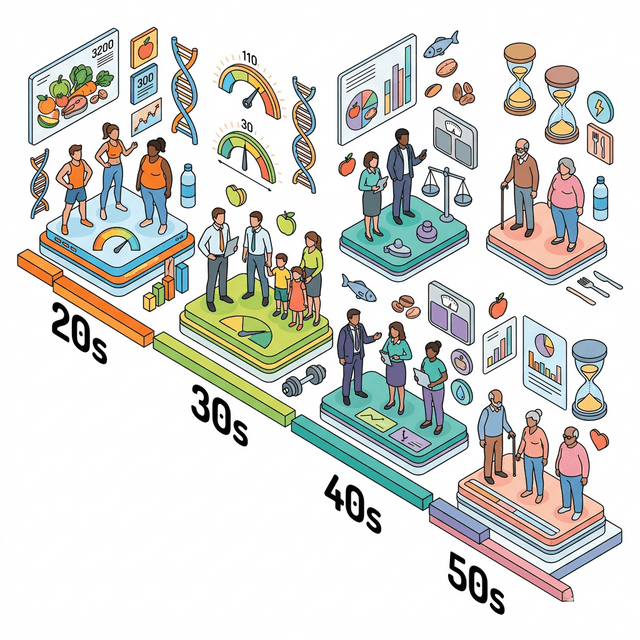
Generally, basal metabolic rate (BMR) peaks in the late teens and drops by about 2-3% every decade thereafter. The primary reasons include:
- Decline in Skeletal Muscle Mass: Unless actively trained, muscle mass gradually decreases after the 20s (early sarcopenia), leading to a lower BMR.
- Reduced Organ Activity: Organs like the liver, kidneys, and heart—which account for half of your BMR—slightly slow down their activity over time.
- Hormonal Shifts: Declines in growth hormone, thyroid hormones, and estrogen (in women) can reduce fat-burning efficiency.
Advice for Each Life Stage
- 20s: High metabolism and fast recovery. A great time to maintain your ideal physique through high protein and consistent activity.
- 30s-40s: When metabolic decline becomes noticeable. Prioritize muscle retention strategies over simple calorie restriction.
- 50s and Beyond: Avoid extreme calorie deficits. Focus on nutritional density, high-quality proteins, and minerals to compensate for reduced digestive capacity.
2. Dynamic Calorie Strategies for Different Body Types
Adjust your calorie settings based on "what's inside," not just the number on the scale.
[The Muscular/Athlete Type]
Those with higher muscle mass require more energy than standard calculators suggest.
- Strategy: Calculate BMR based on Lean Body Mass (LBM) and set activity coefficients one step higher. Ensure sufficient carbohydrate intake to prevent muscle catabolism.
[The Ovoid/Higher Body Fat Type]
TDEE can appear high due to heavy body weight, but adipose tissue has a lower metabolic rate.
- Strategy: Instead of a massive deficit from current weight, base your goals on the maintenance calories for your "Goal Weight." This ensures a more sustainable fat-loss pace.
[The "Skinny Fat" / Low Muscle Type]
Your weight is within range, but your body fat percentage is high.
- Strategy: Drastic calorie cuts will likely cause further muscle loss. Focus on a "Maintenance" intake while prioritizing resistance training to swap fat for muscle (Body Recomposition).
3. The "3:7 Rule" for Adjusting Calculations to Real Life
How should you apply the numbers from Jenee's tool to your day-to-day life?
The Golden Ratio for Starting
For weight loss, a target of 90% of TDEE is highly recommended.
- Example: If TDEE is 2,000 kcal, set your goal at 1,800 kcal.
- Cutting too deep (e.g., down to 1,200 kcal) often triggers an "eco-mode" in the body, which leads to long-term failure.
The 10% Fine-Tuning
Live at your maintenance calories for two weeks and check for:
- Weight Gain: Your metabolism is currently lower than estimated. Reduce by 5-10%.
- Rapid Weight Loss (Over 1kg/week): Risk of muscle loss. Increase by 5%.
- Fatigue/Insomnia: Signs of energy deficiency. Review your carb-to-fat ratios.
4. Hormones and Calories: Female Physiology
For women, cyclic hormonal shifts and menopause significantly impact calorie burn and cravings.
Follicular vs. Luteal Phase
- Follicular Phase (Post-period to Ovulation): Metabolism is stable, and fat burning is efficient.
- Luteal Phase (Pre-period): Basal body temperature rises, increasing daily burn by 50-100 kcal. However, progesterone increases cravings. During this phase, aim for maintenance (TDEE) rather than a deficit.
5. Summary: Own Your Personal Energy Management
The goal of calorie management isn't to obey numbers perfectly. It's to develop a sense of "This intake works best for this activity level."
Body composition and age are constantly evolving. Update your data every six months using Jenee's tools to find the balance that feels best and delivers the results you deserve.
Daily Calorie CalculatorFind your Total Daily Energy Expenditure (TDEE) based on your activity level.FAQ: Frequently Asked Questions
Q1. My appetite dropped as I aged. Did my BMR drop drastically too?
A1. Reduced appetite can be a sign of aging digestion, but it's also your body signaling reduced energy needs. Focus on nutrient-dense foods (quality over quantity) to ensure protein and micronutrient needs are met.
Q2. Should muscular types eat extreme amounts of protein?
A2. While protein needs are higher for muscular individuals, it is crucial not to neglect carbohydrates as an energy source. Insufficient carbs can force your body to catabolize that hard-earned muscle.
Q3. Which is more important: A calculator or my phone's health app?
A3. Use them together! Your health app's step data should inform the "Activity Level" you input into the calculator.
Daily Calorie CalculatorFind your Total Daily Energy Expenditure (TDEE) based on your activity level.Knowing your personalized caloric needs is the foundation of sustainable, rebound-free results.
Try the Tools from This Article
Experience what you've learned with our free tools.