Calorie Management for Weight Loss Plateaus: Scientific Approaches to Breaking the Stall
Struggling with a weight loss plateau? This guide explains the science of homeostasis—why your weight stops moving—and offers proven strategies, from correct 'cheat days' to metabolic re-priming, to get your progress back on track.
Introduction: Converting the "Terror" of the Scale into "Understanding"
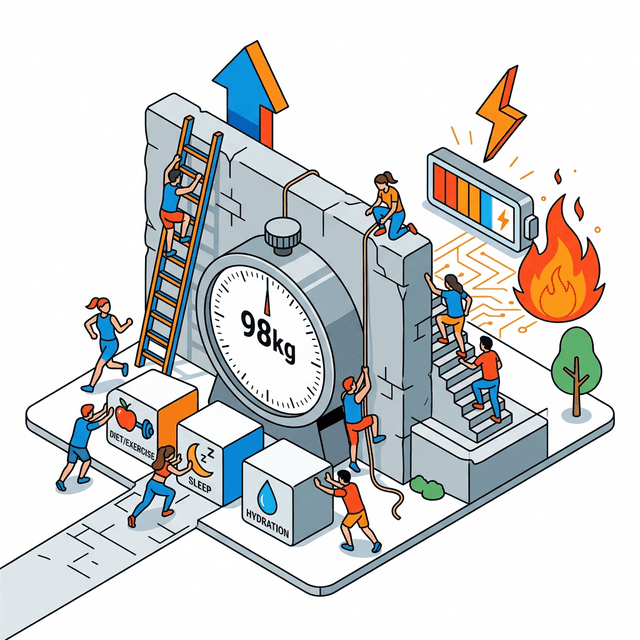
Your weight was dropping steadily, but suddenly, it stops. Even if you eat less or exercise more, not a single gram budges. This "Plateau" is the biggest wall that causes many to give up on their fitness journey.
However, biologically, a plateau is proof that your body is functioning perfectly. It is the result of your survival instinct—Homeostasis—protecting you from what it perceives as a famine.
In this guide, we demystify the science behind why plateaus happen and provide strategic calorie management techniques to re-ignite your metabolism.
1. Why Do Plateaus Happen? The Science of Homeostasis
Your body possesses an incredible ability to maintain a steady internal state, known as "Homeostasis."
Entering "Energy Saving Mode"
When your caloric intake remains below expenditure (deficit) for an extended period, your brain decides: "Energy is scarce. We must minimize consumption to survive."
- Metabolic Adaptation: Your body slows down the BMR by reducing muscle catabolism.
- Unconscious Drop in NEAT: You unconsciously move less—fewer gestures, slower blinking, and less fidgeting.
- Hormonal Shifts: The fat-burning hormone "Leptin" decreases, while the hunger-inducing hormone "Ghrelin" increases.
When you lose about 5% of your body weight, these metabolic brakes often begin to engage powerfully.
Daily Calorie CalculatorFind your Total Daily Energy Expenditure (TDEE) based on your activity level.2. Breaking the Stall (1): "Refeeds" and "Cheat Days"
To release the metabolic brakes, you must reassure your brain that energy is abundant and you are not starving.
The Science of a "Refeed"
Often confused with "Cheat Days," a refeed is more strategic.
- Goal: Specifically increase carbohydrate intake to temporarily boost leptin levels.
- Method: Consume calories equal to or slightly above your maintenance (TDEE), prioritizing carbs while keeping fats low.
- Frequency: Those with lower body fat may need a refeed every 1–2 weeks, while those with higher body fat may only need one every 3–4 weeks.
A Note on "Cheat Days"
While helpful for mental fatigue, consuming excessive high-fat junk food can lead to fat storage. Treat them as "Planned Rewards" rather than a chaotic overfeed.
3. Breaking the Stall (2): Creating "Waves" in Calories
When you eat the exact same calories every day, your body adapts to that cycle. "Calorie Cycling" prevent this adaptation.
- High/Low Strategy: Increase intake on training days (e.g., TDEE +5%) and decrease on rest days (e.g., TDEE -20%).
- Benefit: This prevents metabolic adaptation (eco-mode) while making a long-term deficit easier to maintain psychologically.
The key is "intensity" in both directions rather than a constant, mediocre restriction.
4. The Hidden Enemy: Stress and Cortisol
Calories aren't the only cause of a plateau. Psychological stress and lack of sleep are major contributors.
The Cortisol Effect
Chronic stress induces "Cortisol," a hormone that causes:
- Water Retention: High cortisol triggers the body to hold onto water. Weight may stall on the scale even if fat is being lost (The Masking Phenomenon).
- Solution: A "Diet Break"—taking several days off at maintenance calories to relax—can trigger a "Whoosh Phenomenon," where stored water is released, and weight suddenly drops.
5. Summary: A Plateau is Your Next Step Forward
When a plateau hits, think of it positively: "My program is working, and my body is responding."
Panic-cutting your calories further is often counterproductive. Stop, recalculate your TDEE using Jenee's tool, and introduce a "Strategic Pause" like a refeed or a diet break.
Your body is not a machine—it's a biological system with natural ebbs and flows. Use data as your ally to achieve your goals intelligently.
Daily Calorie CalculatorFind your Total Daily Energy Expenditure (TDEE) based on your activity level.FAQ: Frequently Asked Questions
Q1. How long do plateaus last?
A1. It varies, but it's not unusual for a plateau to last 2 weeks to a month. If there's no change for over 2 weeks, it's a sign to review your diet structure and activity levels.
Q2. Is it effective to exercise more during a plateau?
A2. It can be, but overtraining often increases cortisol, which may worsen the situation via water retention. Starting with calorie cycling is often safer.
Q3. Can eating more actually cause weight loss?
A3. If your metabolism has bottomed out due to extreme restriction, a strategic refeed can "re-set" your metabolic rate and hormonal environment, allowing fat loss to resume.
Try the Tools from This Article
Experience what you've learned with our free tools.