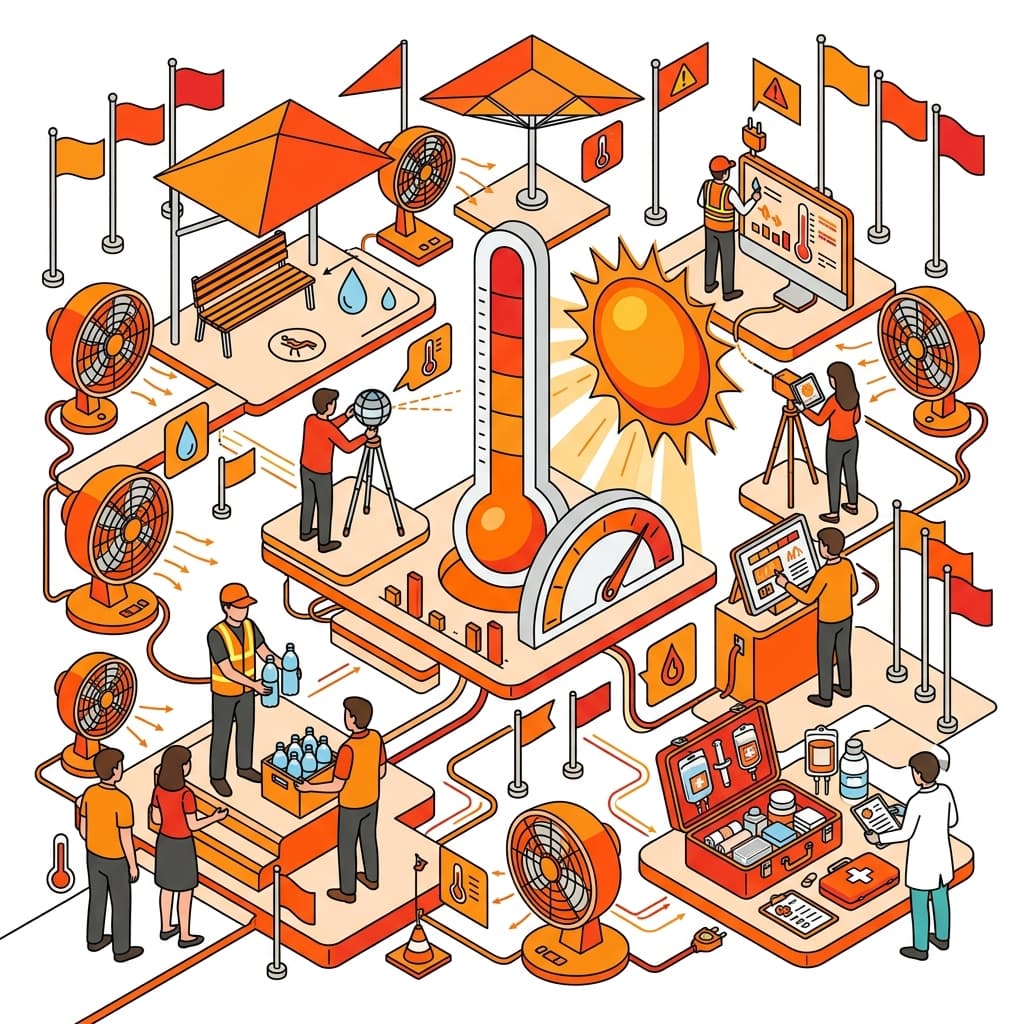
WBGT Heat Stress Index Complete Guide: How to Read Heat Warning Levels and Exercise Restrictions
Learn how WBGT (Wet Bulb Globe Temperature) is calculated, what each danger level means, and what activity restrictions apply. Based on Japan's Heat Warning Alert system and Japan Sports Association guidelines.
What Is WBGT?
WBGT (Wet Bulb Globe Temperature) is the gold-standard index for assessing heat stress risk. Unlike air temperature alone, it combines humidity, radiant heat, and air movement — the three factors that determine how your body actually copes with heat.
Two days might share the same 35°C air temperature, but one with high humidity creates dramatically higher heat stress. WBGT captures this difference accurately.
How WBGT Is Calculated
Outdoor Formula (Natural Ventilation)
WBGT (outdoor) = 0.7 × NWB + 0.2 × GT + 0.1 × DB
- NWB (Natural Wet Bulb Temperature): Temperature of a thermometer wrapped in wet gauze — reflects the cooling effect of evaporation. The dominant factor (70% weight) because humidity most strongly affects heat stress.
- GT (Globe Temperature): Temperature inside a black copper sphere — reflects solar and radiant heat load.
- DB (Dry Bulb Temperature): Ordinary air temperature.
Indoor Formula
WBGT (indoor) = 0.7 × NWB + 0.3 × DB
No globe temperature component since indoor radiant heat load is negligible.
Heatstroke Risk CheckerEstimate Wet Bulb Globe Temperature (WBGT) and heatstroke risk from temperature and humidity. Unit ConverterEasily convert length, weight, temperature, and more on the fly.WBGT Exercise Guidelines (Japan Sports Association)
| WBGT | Risk Level | Exercise Guidance |
|---|---|---|
| ≥31°C | Stop exercise | Cancel all exercise activities. Extreme heatstroke risk. |
| 28–31°C | Severe caution | Stop exercise for unfit or unacclimatized individuals. |
| 25–28°C | Caution | Avoid intense/prolonged exercise. Take frequent breaks. Hydrate actively. |
| 21–25°C | Attention | Heat stress risk increases. Active water and electrolyte replacement needed. |
| <21°C | Nearly safe | Low heatstroke risk under normal conditions. |
Special Considerations for Vulnerable Groups
WBGT thresholds apply to healthy adults. Children, the elderly, and those with medical conditions face risk at lower WBGT levels.
- Children: Underdeveloped thermoregulation; larger surface-area-to-body-weight ratio absorbs heat faster
- Elderly: Reduced heat sensation, decreased sweat production
- Certain medications: Diuretics, anticholinergics, and beta-blockers increase heat stress risk
Japan's Heat Warning Alert System
Japan's Ministry of the Environment and Japan Meteorological Agency issue Heatstroke Warning Alerts by prefecture.
| Alert Level | Trigger | Recommended Action |
|---|---|---|
| Heatstroke Warning Alert | Prefectural WBGT forecast ≥33 | Avoid unnecessary outdoor activity; use air conditioning |
| Heatstroke Special Warning Alert (from 2024) | Nearly all points in prefecture forecast WBGT ≥35 | Strongly discourage all outdoor activity |
Workplace Heat Management
Japan's Ministry of Health, Labour and Welfare recommends WBGT-based heat management in workplaces.
Approximate WBGT limits by work intensity:
| Work Level | Approximate WBGT Limit |
|---|---|
| Resting (minimal movement) | Up to ~33°C |
| Light work (standing, machine operation) | Up to ~28°C |
| Moderate work (walking with load) | Up to ~26°C |
| Heavy work (shoveling, heavy lifting) | Up to ~25°C |
People not yet acclimatized to heat are at highest risk — particularly at the start of the hot season (post-rainy season in Japan).
Practical Heat Precautions by WBGT Level
WBGT 25–28°C (Attention):
- Hydrate every 15–20 minutes (100–200ml per session)
- Seek shade outdoors
WBGT 28–31°C (Caution):
- Avoid intense or prolonged exercise
- Take frequent active rest breaks
- Stay in shade or air conditioning when possible
WBGT ≥31°C (Severe Caution):
- Stop intense exercise entirely
- Prioritize cool indoor spaces
- Heightened vigilance for children, elderly, and unacclimatized individuals
WBGT ≥35°C (Danger):
- Cancel all outdoor athletic events
- Avoid going outside
- Stay in air-conditioned spaces
Hydration Guidelines During Exercise
- During activity: 150–250ml every 15–20 minutes
- Sessions over 1 hour: Water plus sports drink (electrolyte replacement)
- During heavy sweating: 0.1–0.2% saline solution to replace lost sodium
Summary
| WBGT | Risk Level | Primary Action |
|---|---|---|
| ≥31°C | Dangerous / Stop | Cancel all outdoor exercise |
| 28–31°C | Severe Caution | Stop intense exercise; frequent rest |
| 25–28°C | Caution | Regular breaks; active hydration |
| 21–25°C | Attention | Active water and electrolyte intake |
| <21°C | Nearly Safe | Standard precautions |
WBGT is the most accurate publicly available measure of real-world heat stress risk. Use it — not just air temperature — to make safe decisions about summer activities.
Heatstroke Risk CheckerEstimate Wet Bulb Globe Temperature (WBGT) and heatstroke risk from temperature and humidity.Related Articles