The Relationship Between Copywriting Length and Click-Through Rates
Why are the most clicked news headlines exactly 13.5 characters long in Japanese? Discover the cognitive limits of the human brain and the optimal text length for maximizing your Click-Through Rate (CTR).
The Human Cognitive Limit is Exactly "13 Characters"
When we are rapidly scrolling through websites or social media timelines, the average time our eyes spend looking at a single headline or banner ad is shockingly brief—less than 0.5 seconds.
Within this microscopic window, the maximum number of characters the human brain can instantly comprehend without mentally "reading it aloud" is strictly capped by cognitive science at around "13 to 15 characters" (in languages with dense characters like Japanese; in English, this translates roughly to 5-7 words). Yahoo! JAPAN, the country's largest portal site, famously mandated for years that all top news headlines be exactly 13.5 characters long. This was not an aesthetic choice, but a deeply calculated, science-backed weapon.
If your advertisement or blog headline stretches to 20 or 30 characters, the user's brain subconsciously registers it as "too high of a cognitive load to parse." Consequently, even if the actual product is perfectly suited for them, they will swipe past it without a second thought.
Optimal Copy Length by Platform
The exact character count required to completely maximize your Click-Through Rate (CTR) dynamically changes based on the "mindset" of the user on that specific platform.
1. Banner Ads & In-Image Social Text (10 to 15 chars / 3-5 words)
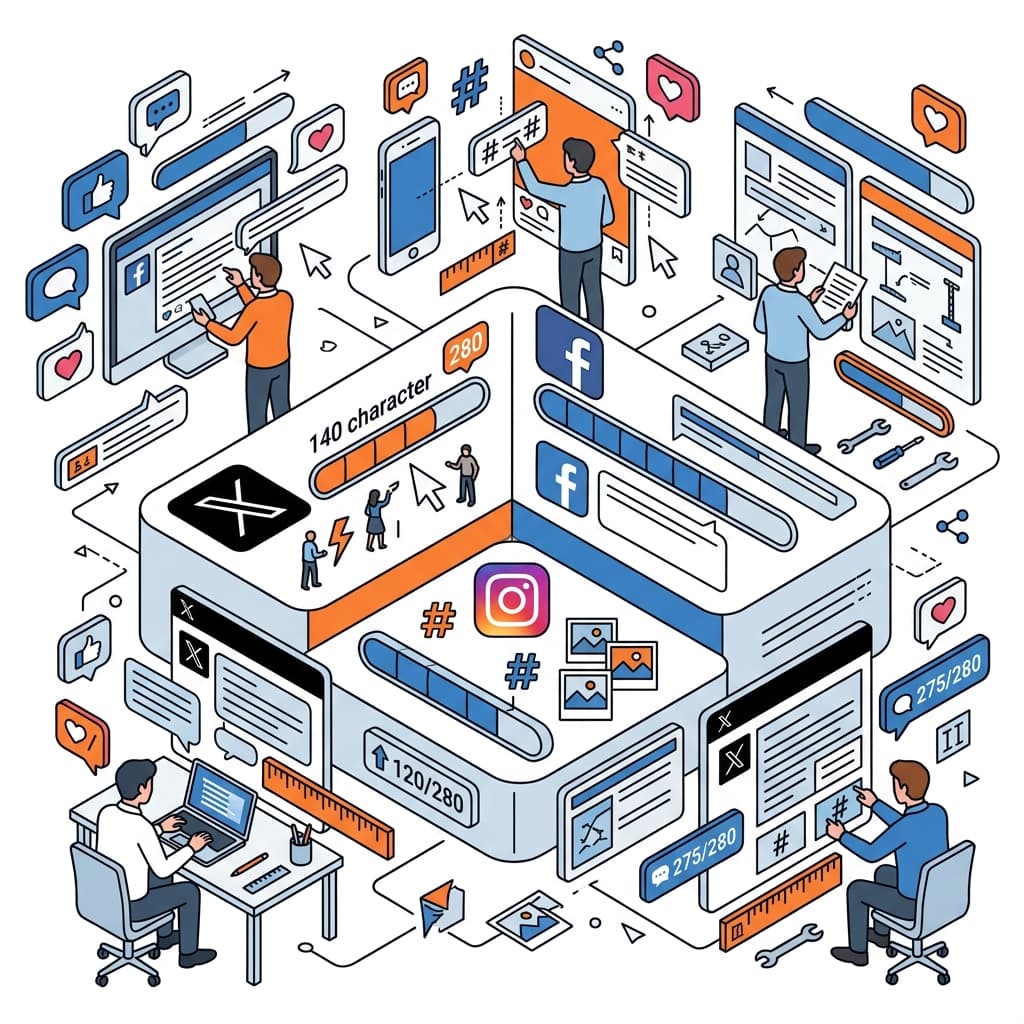
For ad graphics flowing through Instagram or X (Twitter), the golden rule is extreme brevity. You must distill "Who this is for" and "What it does" into a razor-sharp, single phrase and display it massively. Any secondary supplementary information must be banished to the bio or caption text outside the image.
2. Email Subject Lines (15 to 20 chars / 5-8 words)
The subject line of a marketing or sales email must be strictly confined to the exact character limit that displays fully on a smartphone lock screen before getting brutally cut off. Generally, anything past roughly 20-25 characters is replaced by an ellipsis ("..."). The ultimate key to skyrocketing open rates is front-loading the most critical "benefit" or "numerical data" into the very first 10 characters.
3. SEO Article Title Tags (28 to 32 chars / 8-12 words)
When users are actively typing queries into Google to solve a specific, painful problem, they are willing to digest slightly longer, highly descriptive text. The universal SEO optimum is hovering around 30 characters—the exact limit where Google truncates titles on mobile and desktop displays. Your task is to surgically cram primary search keywords and user benefits into this specific limit.
Letter & Word CounterCount characters, words, and paragraphs for essays or social media.The "Segmentation Technique" for Long Copy
What happens if your product is so complex that it is fundamentally impossible to convey its value in under 15 characters? You utilize the "Element Segmentation Technique."
You force the primary catch-copy (the main headline) to be brutally short, and flank it with a "Lead Copy" above and a "Sub Copy" below.
- Lead Copy (Small Font): "For those working late nights every single day..."
- Main Copy (Massive Font, 5 Words): "5-Minute Gourmet Post-Work Meals"
- Sub Copy (Medium Font): "30 time-saving microwave recipes requiring absolutely no stove cooking."
By establishing this aggressive visual hierarchy (Jump Rate), the brain instantly scans and locks onto the short, punchy "5-Minute" phrase. Only if that core 5-word hook successfully captures their interest will their brain voluntarily decide to read the smaller supplementary text surrounding it.
Conclusion: Copywriting is the Art of "Amputation"
The most spectacular failure of amateur copywriters stems from the desperate desire to "convey every single amazing feature of the product." They bloat the copy with endless adjectives and technical jargon.
"The world's most talked-about, latest-technology-equipped, beginner-friendly, revolutionary fully-automatic vacuum cleaner." This completely paralyzes the reader's brain.
The singular purpose of a catch-copy is never to "explain the entire product." Its sole, ruthless objective is to "ignite a spark of curiosity forcing them to click to the next page." Aggressively utilize character counting tools to relentlessly amputate useless words, honing your sentence down into a razor-sharp, 13-character blade that pierces directly into the user's brain.
Related Articles