The Hidden Risk of Cash Savings: How Inflation Erodes Your Wealth
The conventional wisdom that 'money is 100% safe in the bank' is a dangerous illusion during an era of inflation. Understand the brutal mechanics of how rising prices silently evaporate your purchasing power.
The Colossal Trap of "Keeping It Safe in the Bank"
"Investing in the stock market is terrifying; keeping 100% of my wealth in a bank savings account is the absolute safest choice." In countries that have experienced prolonged periods of deflation, this generational wisdom technically held true. After all, the numerical face value printed in your bank ledger never magically decreases.
However, the exact moment an economy shifts into an era of "Inflation" (rising consumer prices), this hyper-conservative strategy of "100% Cash Allocation" instantly transforms into an incredibly dangerous gamble highly guaranteed to erode your wealth.
In this article, we will dissect the brutal, invisible financial mechanism of how your purchasing power quietly evaporates into thin air, even while your bank account numbers remain entirely unchanged.
Inflation is Fundamentally the "Devaluation of Currency"
Imagine you have exactly $10,000 sitting in your bank account, and the beautiful used car you have been dreaming of buying happens to cost exactly $10,000 today. In other words, your $10,000 currently holds the "purchasing power" equivalent to exactly one car.
Now, imagine the country enters an inflationary period, and the price of goods rises by an average of 4% every single year. Fast forward 10 years: that exact same car has surged in price and now costs approximately $14,800.
What happened to your bank savings during that decade? At typical modern bank interest rates (e.g., 0.1%), your $10,000 has barely grown at all, remaining practically static.
Ten years ago, your $10,000 was fully capable of purchasing a car. Today, it is $4,800 short. The numbers in your bank ledger haven't dropped by a single cent, yet a massive chunk of your wealth has vanished.
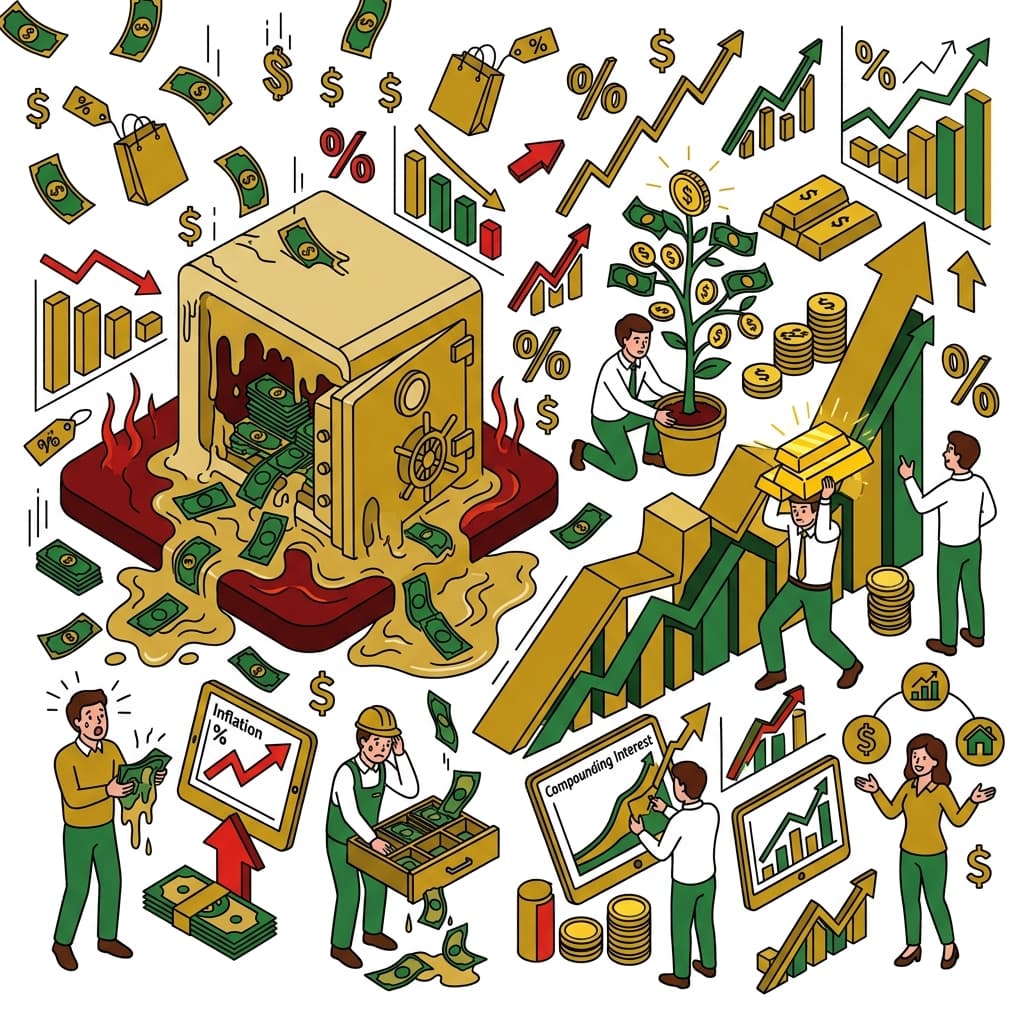
This is the silent horror of "real-value depreciation." Every time the price of eggs doubles at the supermarket, or your utility bills spike, the inherent "purchasing power" of the cash sleeping under your mattress or in the bank melts away like ice left out in the summer sun.
Asset Formation SimulatorSimulate compound interest and future wealth from recurring investments.Why the Ultra-Wealthy Hate Holding Cash
The world's ultra-wealthy, billionaires, and elite institutional investors almost never hoard their net worth in raw cash. They view fiat currency as an incredibly high-risk asset that is mathematically guaranteed to lose value over a long timeline.
To fiercely protect their empires from the beast of inflation, they immediately convert their cash into hard assets and financial vehicles: "Equities (Stocks)," "Real Estate," and "Commodities (like Gold)." Why? Because when inflation strikes and prices surge, corporate revenues and profits naturally rise (driving up stock prices), rent and land values soar (driving up real estate), and finite raw materials become more highly demanded (driving up gold).
By parking their wealth in appreciating assets rather than cash, they ensure their net worth automatically inflates in tandem with the economy, surfing the wave of inflation rather than drowning underneath it.
Conclusion: Investing as the Ultimate "Defensive Armor"
You must violently discard the misconception that "Investing is just high-stakes gambling to get rich quick." In an inflationary era, utilizing tax-advantaged accounts or steadily purchasing broad-market index funds is not an aggressive offensive strategy—it is your absolute minimum defensive armor required to prevent your life savings from rotting away.
To be abundantly clear: you absolutely must keep your "Emergency Fund" (3 to 6 months of living expenses) and any money you need within the next five years (like a house down payment) in a safe, deeply liquid bank account.
However, allowing your long-term "surplus capital"—money you won't touch for over a decade—to stagnate in cash is financially equivalent to hoarding water in a bucket riddled with holes. Understand the catastrophic hidden risk of cash, and take your very first step into investing—even with a tiny monthly amount—to generate a yield that can outpace inflation and secure your financial future.