Smart Summer Electricity Saving: Proper AC Usage and Energy Conservation Tips
Practical strategies to reduce summer electricity bills. Covers optimal AC settings, energy-saving habits, and how to simulate your power costs.
Summer electricity bills peak for most households due to air conditioning. The goal isn't to suffer through heat — it's to stay cool efficiently, paying only for the comfort you actually need.
Where Summer Electricity Goes
In a typical household, air conditioning accounts for 50–60% of summer electricity consumption. Refrigerators (14–15%) and lighting (10–15%) follow. Optimizing AC usage delivers the biggest return on attention.
Electricity Bill SimulatorCalculate estimated electricity costsSmart Air Conditioning
Target temperature: 28°C (but prioritize comfort) Japan's Ministry of the Environment recommends 28°C for cooling. Each degree increase in setting reduces power consumption by approximately 10–13%.
Leave it on or turn it off? For absences under 30 minutes, leaving the AC on consumes less energy than the startup surge of restarting. For absences over 1 hour, turning it off saves power.
Use auto mode Auto mode adjusts temperature, humidity, and fan speed dynamically — more efficient than a fixed high-fan/low-temperature setting.
Clean filters every 2 weeks Clogged filters reduce cooling efficiency by approximately 4%. Clean before summer begins and maintain throughout the season.
Beyond AC: Energy-Saving Habits
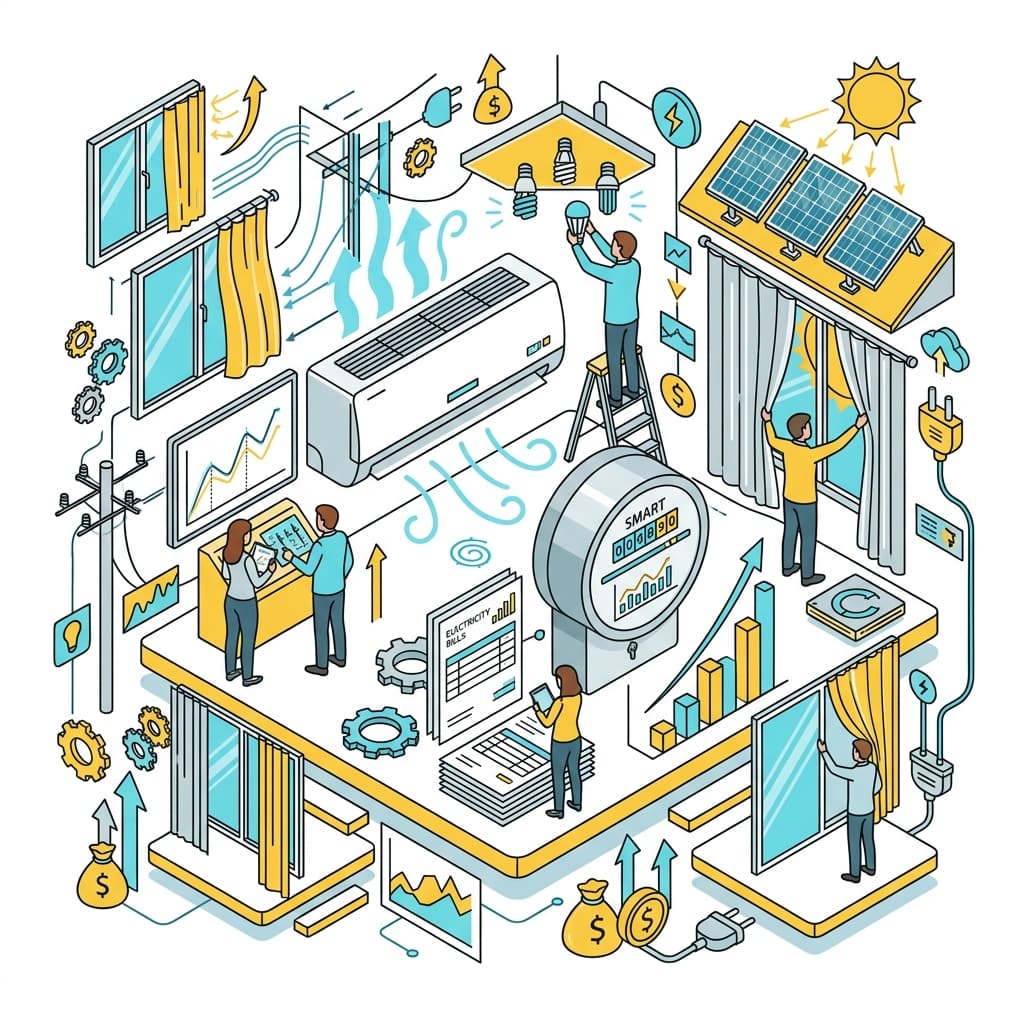
Heat-blocking curtains and window film Blocking radiant heat through windows reduces the room temperature load on your AC by 10–25%.
Combine AC with a fan A fan circulating air allows you to raise the AC setting by 2–3°C while maintaining the same perceived comfort. Fans use less than 1/10 the power of AC — a significant combined saving.
Eliminate standby power Appliances draw power even when off. Standby consumption accounts for roughly 5–6% of annual household electricity use. Unplug devices that sit unused for extended periods.
Optimize the refrigerator
- Keep the setting at "medium" — summer rarely requires maximum cooling
- Allow 10+ cm clearance around sides and back for heat dissipation
- Don't overfill; allow cold air to circulate
- Cool hot food before refrigerating
LED lighting If you haven't switched to LED, doing so reduces lighting energy use by ~80%.
Electricity Bill SimulatorCalculate estimated electricity costsFAQ
Q: Is replacing an old AC unit worth the electricity savings? A: Models from 10+ years ago often use 20–40% more energy than modern equivalents. Calculate your current unit's annual consumption versus a new model's APF rating to assess payback period.
Q: What's a typical summer electricity bill? A: A 4-person Japanese household averages ¥15,000–18,000 in August. This varies widely by region, home size, and insulation quality.
Q: How do I balance energy savings with heatstroke risk? A: For households with elderly members, infants, or anyone in poor health — comfort and safety come before cost savings. On days exceeding 35°C, use AC without hesitation. Save electricity only within the bounds of health safety.
Summary
AC efficiency is the biggest lever for summer electricity savings. Combine optimal temperature settings, clean filters, fans, and heat-blocking window treatments to maintain comfort while cutting costs by 10–30%. Use the electricity simulator to calculate how these changes apply to your specific situation.