Speed Reading Techniques and Reading Time Calculation: Boost Your Reading Efficiency
Learn evidence-based speed reading techniques and how to calculate reading time. Practical advice for reading business and technical books more efficiently.
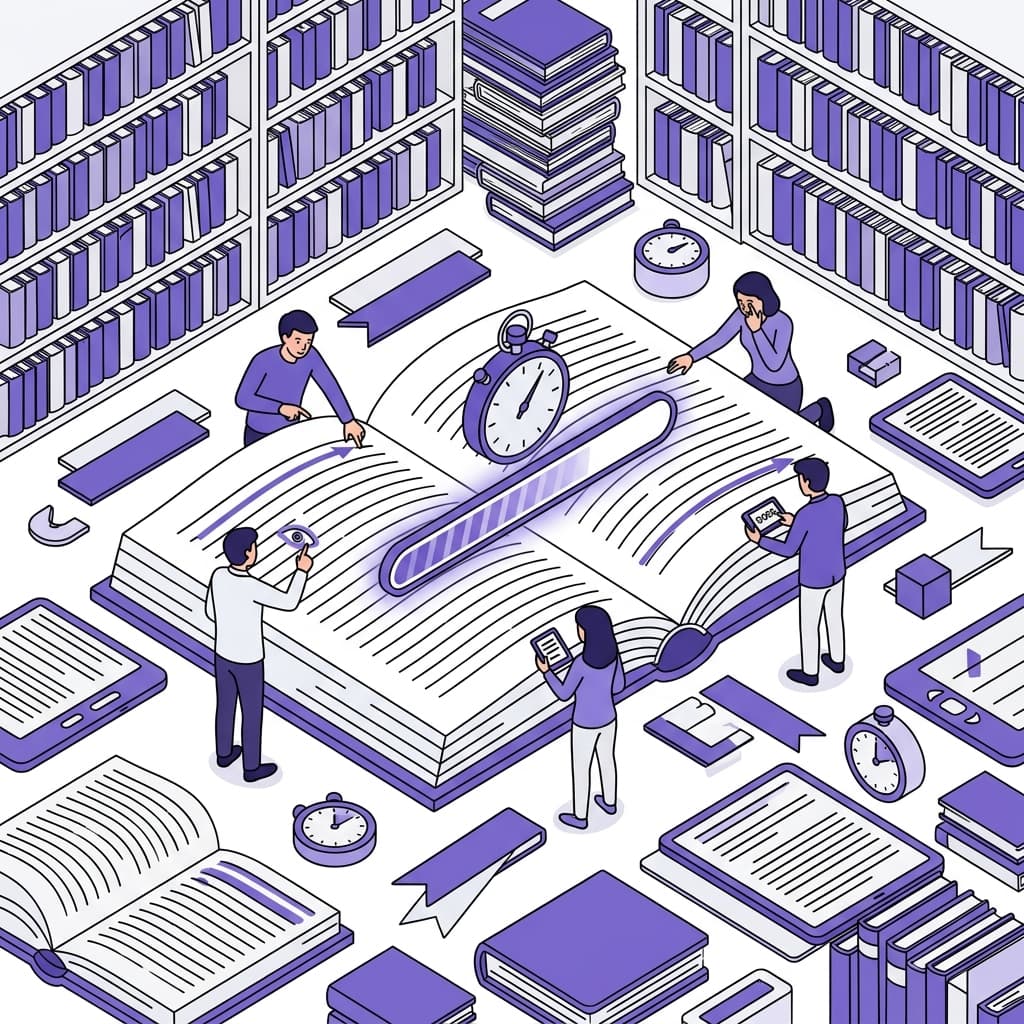
With endless reading on to-do lists and limited hours, reading efficiency has become a professional skill. Speed reading isn't just reading faster — it's reading at the right speed for the right purpose.
Reading Speed Fundamentals
Average reading speeds:
- Japanese: ~400–600 characters per minute
- English: ~200–300 words per minute
Estimated reading times (at 500 chars/min for Japanese; 250 wpm English):
| Content | Characters | Time |
|---|---|---|
| Business book (200 pages) | ~80,000 chars | ~160 min |
| Technical book (300 pages) | ~120,000 chars | ~240 min |
| Web article | ~3,000 chars | ~6 min |
Evidence-Based Speed Reading Techniques
1. Reduce subvocalization Most readers silently "say" words in their heads as they read — this limits reading speed to speaking speed (~300 wpm). Practice visual word recognition without internal narration to break through this ceiling.
2. Expand your visual span The eye only reads clearly in a small central zone. Training yourself to take in 2–4 words per eye fixation (rather than one) is the core of speed reading. Using a finger or pointer to guide scanning pace is effective practice.
3. Skimming and scanning
- Skimming: Read headings, bold text, and the first and last sentences of each section to get structure and main ideas before full reading.
- Scanning: Search for specific keywords to extract targeted information. Essential for reference books.
4. SQ3R Method An evidence-based academic reading strategy:
- Survey: Review chapter titles, headings, figures
- Question: Ask what you want to learn from each section
- Read: Read with your questions in mind
- Recite: After each section, summarize in your own words
- Review: Revisit the whole chapter after reading
Reading Strategies by Content Type
Business books Most business books argue one central idea. Efficient approach:
- Read the table of contents (5 min)
- Read the introduction and conclusion (10 min)
- Read the first and last paragraphs of each chapter (20 min)
- Deep-read the most relevant chapters
Technical and academic books These require sequential reading — later chapters build on earlier ones. Adjust pace by difficulty rather than applying uniform speed.
Fiction and essays Speed reading reduces enjoyment of narrative and prose. For pleasure reading, slow down and experience the language fully.
FAQ
Q: Does speed reading reduce comprehension? A: Proper technique maintains or improves comprehension. "Reading with questions" particularly enhances retention by directing attention. For dense technical material, however, slow careful reading outperforms speed reading.
Q: If I read 30 minutes daily, how many books per year? A: At 250 wpm for 30 minutes daily, you'd read roughly 22–28 typical business books per year (based on ~65,000-word books). Use the reading time calculator with your specific target book length.
Q: E-book vs. paper — which is faster? A: Research shows minimal difference for general reading. For technical content with complex diagrams, paper often aids comprehension. E-books offer useful advantages: adjustable font size, instant search, and annotations.
Summary
Speed reading mastery is about matching your reading approach to your purpose. Calculate expected reading time in advance, choose the appropriate mode (deep reading, skimming, or scanning), and use structured methods like SQ3R to maximize retention. The result: more knowledge from the same time investment.