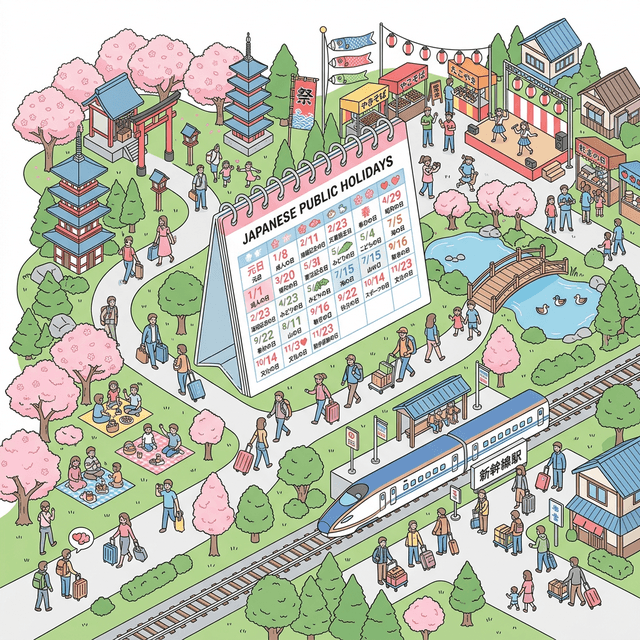
Japan's Public Holidays Explained: Maximize Long Weekends with Date Calculation
A clear guide to Japan's public holidays, including substitute holidays and Happy Monday rules. Learn how to use date calculation tools to plan trips, manage work schedules, and make the most of long weekends.
Why Knowing Japan's Holiday Rules Matters
"How many days is Golden Week this year?" "If a public holiday falls on Sunday, is Monday off too?" "When is Silver Week, and is it actually a long weekend?"
Japan's holiday system is more complex than it might appear. There are fixed holidays, floating holidays, substitute holidays, and special "sandwiched day" rules. Understanding how they work helps you plan vacations, manage project deadlines, and avoid calendar surprises.
This guide breaks down Japan's public holiday system and shows you how to use date calculation tools to make the most of every long weekend.
Date & Days CalculatorCalculate the exact number of days between dates or add days to a date.How Japan's Public Holidays Work
Types of Public Holidays
Japan currently has 16 official public holidays, established under the Act on National Holidays. They fall into three categories:
① Fixed-date holidays: The same date every year
- New Year's Day (Jan 1), Foundation Day (Feb 11), Emperor's Birthday (Feb 23)
- Showa Day (Apr 29), Constitution Memorial Day (May 3), Greenery Day (May 4), Children's Day (May 5)
- Mountain Day (Aug 11), Culture Day (Nov 3), Labour Thanksgiving Day (Nov 23)
② Happy Monday holidays: Fixed to specific Mondays to guarantee three-day weekends
- Coming of Age Day (2nd Mon in Jan), Marine Day (3rd Mon in Jul)
- Respect for the Aged Day (3rd Mon in Sep), Sports Day (2nd Mon in Oct)
③ Astronomical holidays: Determined by observation and announced in February each year
- Vernal Equinox Day (~Mar 20–21)
- Autumnal Equinox Day (~Sep 22–23)
The Substitute Holiday Rule
When a public holiday falls on a Sunday, the following Monday becomes a "substitute holiday" (振替休日). This is guaranteed by law.
However, if a holiday falls on a Saturday, no substitute holiday is granted. The holiday is simply lost. This surprises many people who assume Saturdays are treated the same as Sundays.
The "Sandwiched Day" Rule
Under Article 3, Paragraph 3 of the Holiday Act, any weekday sandwiched between two public holidays automatically becomes a public holiday. This occasionally creates bonus days off — particularly in September if Respect for the Aged Day and Autumnal Equinox Day fall with a weekday between them.
Japan's Major Holiday Seasons
Golden Week (Late April – Early May)
Golden Week clusters several fixed holidays between April 29 and May 5. Combined with surrounding weekends and substitute holidays, it can extend to 9–10 consecutive days off in favorable years.
The exact length of Golden Week varies significantly each year — by as many as 3–4 days — depending on how weekdays align with holidays. Checking the current year's calendar early is essential for travel booking and project planning.
Silver Week (September)
Silver Week — a September equivalent of Golden Week — only occurs once every few years, when Respect for the Aged Day and Autumnal Equinox Day fall close together with a weekday in between that triggers the sandwiched day rule.
When Silver Week does happen, it typically creates a 5-day consecutive holiday. Because it's irregular, many people are caught off guard when it appears or disappears.
Year-End / New Year (Late December – Early January)
Legally, only January 1st is a public holiday in this period. However, most government offices, banks, and businesses observe an unofficial holiday from December 29 to January 3. Depending on the day of the week, the practical holiday period ranges from 6 to 9 days.
Business Implications of Japan's Holidays
Deadlines and Contract Periods
Misunderstanding holidays can cause serious business problems:
- A "14-day deadline" clause may mean 14 calendar days — regardless of public holidays
- "5 business days" in late April could span 2+ weeks once Golden Week is factored in
- A contract signed on March 20 may require different calculations depending on whether Vernal Equinox Day falls that day
Using a date calculation tool before finalizing deadlines removes this guesswork.
Bank Transfer Cutoffs
Bank transfers in Japan do not process on holidays, weekday evenings after cutoff times, or December 31–January 3. Month-end payments (月末払い) that fall on a holiday are carried over to the next business day.
For finance teams managing cash flow, a clear holiday calendar combined with date arithmetic tools is indispensable.
Travel Planning Tips
Finding the Best Long Weekend
With a date calculation tool, you can:
- Count exactly how many days are in any upcoming long weekend
- Compare holiday counts across different months to find optimal travel windows
- Calculate the countdown to your planned departure date
Bridging "Island Holidays" with Paid Leave
Japan frequently has "island holidays" (飛び石連休) — a public holiday on Thursday or Tuesday with a regular workday in between. Taking just one day of paid leave can turn these into a 4–5 day weekend. Spotting these opportunities requires knowing the holiday calendar in advance.
Date & Days CalculatorCalculate the exact number of days between dates or add days to a date.Frequently Asked Questions
Q1. What's the difference between a substitute holiday and the "sandwiched day" rule?
A substitute holiday (振替休日) occurs when a public holiday falls on Sunday — the following Monday becomes a holiday. The sandwiched day rule (国民の祝日) creates a holiday when a regular weekday is surrounded on both sides by public holidays. Both rules can combine to extend holiday periods.
Q2. Does a holiday on Saturday create a substitute holiday?
No. The substitute holiday rule only applies when a holiday falls on Sunday. A public holiday on Saturday is simply observed and not compensated with an extra day off.
Q3. When did the Happy Monday system start?
In January 2000, Japan amended the Holiday Act to move four holidays — Coming of Age Day, Marine Day, Respect for the Aged Day, and Sports Day — to fixed Mondays. Before that, they had fixed dates (e.g., January 15 for Coming of Age Day). The change guaranteed three-day weekends for these holidays every year.
Q4. How many public holidays does Japan have per year?
Japan has 16 public holidays per year. With substitute holidays and sandwiched day bonuses, the actual number of holiday days in any given year ranges from 16 to 19+.
Q5. Where can I find the official annual holiday calendar?
The Cabinet Office (内閣府) publishes the official list at their website. An annually updated CSV file is also available for programmatic use. Combine it with a date calculation tool for precise scheduling.
Conclusion: Know the Holidays, Master Your Time
Japan's public holiday system involves fixed dates, floating Mondays, substitute rules, and sandwiched-day bonuses. Understanding all these layers gives you a clear edge in travel planning, work scheduling, and deadline management.
Use Jenee's date calculation tool to instantly count down to any holiday, verify deadlines, or plan your next long weekend getaway.
Date & Days CalculatorCalculate the exact number of days between dates or add days to a date.