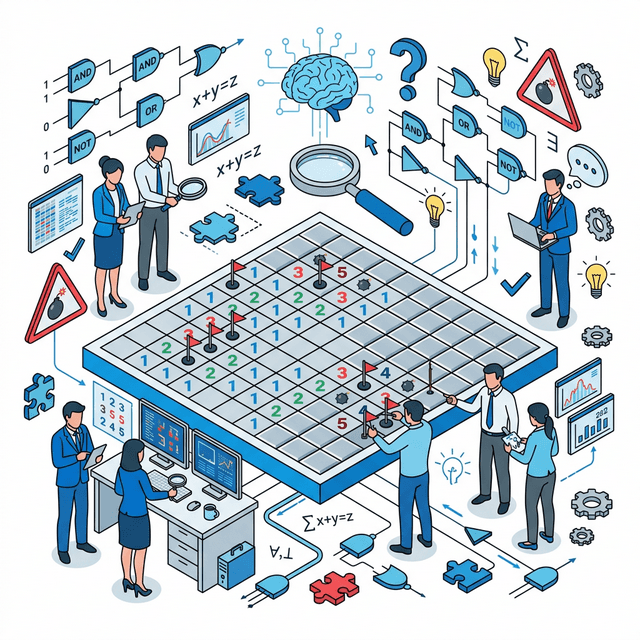
The Best Brain Workout: How Minesweeper Sharpens Logical Thinking
Minesweeper is more than just a game. Learn the science behind how it builds logical reasoning, number interpretation, probabilistic thinking, and deadlock strategies.
That Old Windows Game Is Actually Surprisingly Deep
Most people remember Minesweeper as the classic game bundled with Windows. If your impression is "just clicking randomly until you hit a mine," you might be surprised to learn that Minesweeper is actually an excellent exercise in logical reasoning, probabilistic thinking, and pattern recognition.
Expert Minesweeper players can complete the Expert board (30×16 squares, 99 mines) in under one minute — not by clicking fast, but by executing highly efficient logical processes at incredible speed.
MinesweeperPlay classic Minesweeper! Use logic to clear the board without detonating bombs.The Rules and What the Numbers Mean
Basic Rules
- A grid contains hidden mines in some squares
- Clicking a square reveals a number, blank, or mine (game over)
- Numbers indicate how many mines are in the 8 adjacent squares
- Right-click to flag squares you believe contain mines (optional)
- Reveal all non-mine squares to win
Understanding Numbers Completely
A "2" means exactly 2 mines are hidden among its 8 neighboring squares. Combining information from multiple numbers lets you logically determine safe squares and mine locations.
Logical Reasoning Examples
Pattern 1: Definitive Deduction
If a "1" square has 7 of its 8 neighbors already revealed, the remaining unrevealed neighbor must contain the mine. This is certain — no guessing required.
Pattern 2: Differential Analysis (Subset Analysis)
The most powerful Minesweeper technique is subset analysis. When one number's "unrevealed neighborhood" is a complete subset of another number's, you can subtract the mine counts:
- Mines in larger region − Mines in smaller region = Mines in the difference area
This lets you identify safe squares and mines that neither number could confirm alone.
Pattern 3: Probabilistic Reasoning
Not every position can be solved logically. When multiple squares could equally be mines, choose the square with the lowest probability of containing a mine.
For example, if 3 unrevealed squares must contain exactly 1 mine, each has a ~33% mine probability. Any constraint that forces one particular square to be a mine raises that square's probability to 100%.
How Minesweeper Builds Cognitive Skills
1. Deductive Reasoning
"If this number is X, then that square must contain a mine." This definitive logical thinking underlies mathematics, legal reasoning, and software debugging.
2. Inductive Reasoning and Pattern Recognition
Repeated play builds a library of patterns: "I've seen this configuration before." This cognitive process mirrors machine learning concepts.
3. Working Memory and Information Management
Processing constraints from multiple numbers simultaneously strengthens working memory — the ability to hold and manipulate information while solving a problem.
4. Risk Assessment and Decision-Making
Choosing which risk to take under uncertainty is a transferable skill for business decisions, investing, and everyday problem-solving.
5. Sustained Concentration
One misclick ends the game, training you to maintain focused attention under pressure.
Reaction TestTest and improve your visual reaction time in milliseconds. Typing Speed TestTest your typing speed (WPM) and accuracy with engaging practice texts. Mental Math SprintRace against the clock in this 60-second rapid mental math challenge. MinesweeperPlay classic Minesweeper! Use logic to clear the board without detonating bombs.Difficulty Levels and Strategy
Beginner (9×9, 10 mines)
Start here. Low mine density means large blank cascades are common, providing lots of information quickly.
Tips:
- Click near the center first (more likely to trigger a cascade)
- Practice simple "1" and "2" patterns
- Use flags generously to track confirmed mines
Intermediate (16×16, 40 mines)
More complex patterns require conscious use of subset analysis.
Tips:
- Actively apply differential analysis
- Clear corners and edges first when stuck
- Use probability when logic reaches its limit
Expert (30×16, 99 mines)
High mine density makes probabilistic reasoning essential.
Tips:
- Scan the whole board before diving into local analysis
- Prioritize locally solvable regions
- Practice "global reasoning" by connecting multiple local patterns
Speedrunning Techniques
Chording
Chording is clicking a number when the correct number of adjacent flags are placed, automatically opening all remaining adjacent squares. Combining flag placement (right-click) and immediate chording (left-click) is the key to fast times.
Mouse Optimization
- Use software that supports middle-click chording
- Adjust DPI for optimal cursor speed
- Develop smooth click patterns to minimize hesitation
Minesweeper Is NP-Complete
Minesweeper belongs to the class of NP-complete problems in computational complexity theory — the same class as the Traveling Salesman Problem and Boolean Satisfiability. This means that for certain board configurations, determining mine placement is computationally as hard as the most difficult problems in computer science.
This doesn't mean every position is unsolvable by logic — most positions can be solved deterministically. But it explains why a small fraction of positions require genuine guessing, and why this seemingly simple game has such deep mathematical structure.
Frequently Asked Questions
Q1. Is Minesweeper a game of luck or skill? A. Both. The majority of positions are solvable through pure logic (strong skill element), while some opening moves and certain endgame configurations require guessing (luck element). Skilled players maximize the logical portion and minimize pure guesses, achieving consistently high completion rates.
Q2. How do I improve my Minesweeper time? A. Three main strategies: ①Master chording (flag a mine, then click its number to open surrounding safe squares), ②Look-ahead (move your eyes to the next target while clicking the current one), ③Early-game pattern recognition (develop intuition for first few clicks that open large areas). Master Beginner before advancing in difficulty.
Q3. Is Minesweeper good for children's education? A. Starting with Beginner mode, it's an excellent introduction to logical thinking. Playing while explaining reasoning aloud — "why is this square safe?" — builds both logical and verbal skills. As with any game, set appropriate time limits and balance with other activities.
Summary: Daily Brain Training with Minesweeper
Minesweeper is an excellent brain workout that develops:
- Deductive and definitive logical thinking
- Subset analysis and pattern recognition
- Probabilistic risk evaluation
- Working memory and sustained focus
Next time you have a spare moment, try it. The first few games will feel frustrating, but patterns will become clear with repetition — and that progression IS the brain training.
MinesweeperPlay classic Minesweeper! Use logic to clear the board without detonating bombs.