Does Multitasking Kill Productivity by 40%? The Brain Science Behind Why We Can't Actually Multitask
Think you're good at multitasking? You might be wrong. Research from the American Psychological Association shows multitasking can reduce productivity by up to 40%. Discover what's really happening in your brain and how to reclaim your focus.
The "Good at Multitasking" Myth
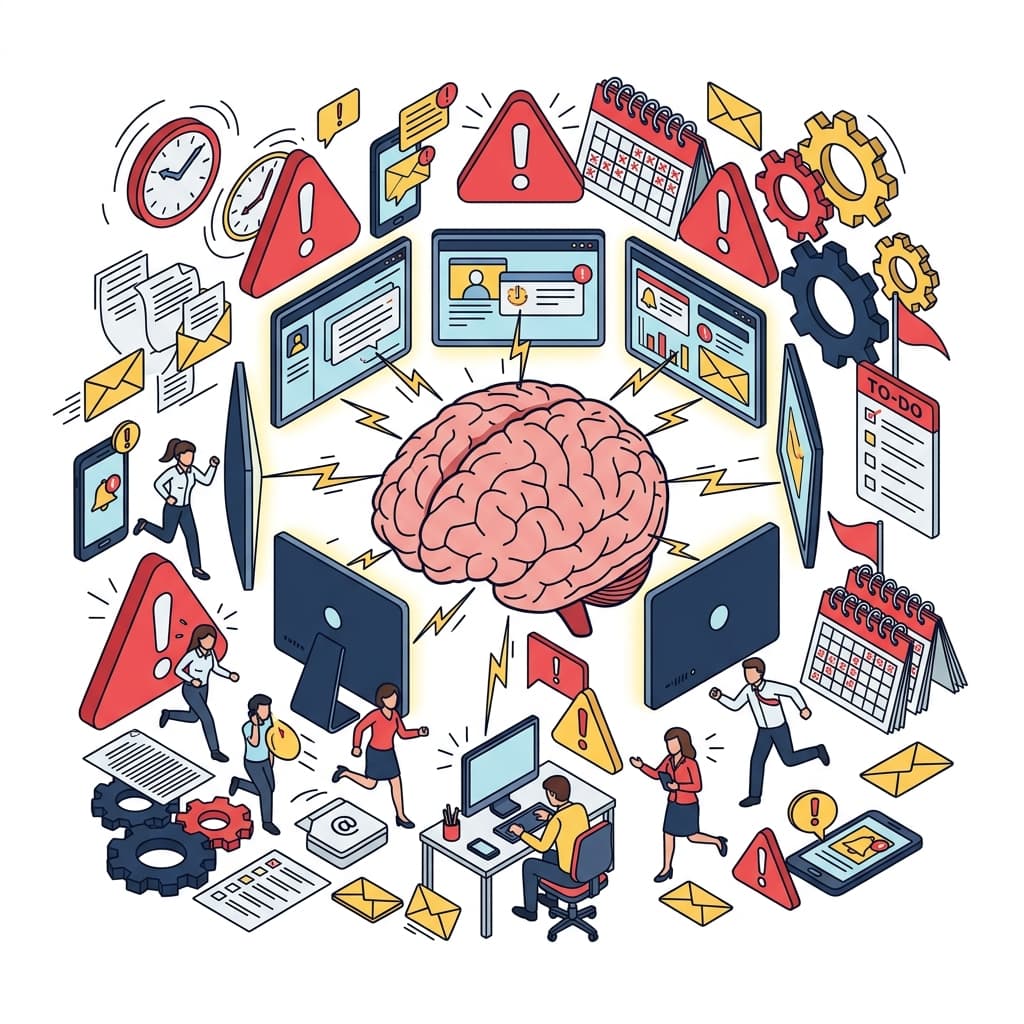
Checking your phone while working, or replying to emails during a meeting — we call this "multitasking." But the human brain fundamentally cannot process two cognitive tasks simultaneously. This has been consistently demonstrated by brain scientists and cognitive psychologists.
According to research from the American Psychological Association (APA), multitasking can reduce productivity by up to 40%. Research by Dr. Gloria Mark at UC Irvine found that once you're interrupted, it takes an average of 23 minutes to fully regain your original level of focus.
Why the Brain Can't Actually Multitask
It's Task Switching, Not Parallel Processing
What we call "multitasking" is actually task switching — rapidly alternating between tasks rather than truly processing them simultaneously. Every switch requires the brain to complete two cognitive steps: goal shifting (updating the active goal) and rule activation (loading the rules for the new task). These switching costs add up to create significant inefficiency.
The Limits of the Prefrontal Cortex
The prefrontal cortex — responsible for focus, judgment, and working memory — has a finite processing capacity. Research by Dr. David Meyer at the University of Michigan (2001) demonstrated that task switching causes "mental blocking," substantially reducing processing efficiency for each individual task.
The Real Costs of Multitasking
1. More Errors
Studies show that performing multiple tasks in parallel can increase error rates 2–3 times compared to focusing on a single task. This is why typos in important emails and calculation mistakes happen more when you're juggling tasks.
2. Faster Cognitive Fatigue
Each task switch consumes cognitive resources. Extended multitasking exhausts the prefrontal cortex, causing the afternoon "energy crash" that many people experience. Without proper rest, this fatigue doesn't recover on its own.
3. Worse Memory Retention
Research suggests that information learned during multitasking tends to be stored in the striatum (for habitual behaviors) rather than the hippocampus (for declarative memory), making it harder to consciously recall later.
4. Reduced Creativity
Deep thinking and creative insights depend on the Default Mode Network (DMN) — a brain state that requires mental quiet. Constant task switching and notification-checking suppress this network, making it harder to generate original ideas.
Practical Strategies to Reclaim Focus
The Pomodoro Technique
The Pomodoro Technique is highly effective for combating multitasking tendencies:
- 25 minutes: Complete focus on one task (phone on silent)
- 5 minutes: Short break
- Repeat 4 times, then take a 15–30 minute longer break
Time Blocking
Divide your day into blocks: "email block," "creative work block," "meetings block." Within each block, focus on only one type of task.
- Schedule demanding cognitive work (writing, analysis) during high-focus morning hours
- Reserve light tasks (email replies, admin) for lower-focus afternoon hours
Turn Off Notifications
Research shows that just receiving a notification (even without checking it) consumes cognitive resources. During focus work:
- Put your phone in another room or out of sight
- Turn off email and chat notifications
- Communicate to colleagues that you're in a focus block
Single-Tab Browsing
Multiple open browser tabs are another form of multitasking. Adopt a single-tab principle — only open tabs directly relevant to your current task.
FAQ
Q: Some people claim to be good at multitasking. Are they right? A: Research shows a paradox: people who believe they're great multitaskers actually perform worse on multitasking tests (Hambrick et al., 2010). The feeling of competence may itself be an illusion.
Q: Is listening to music while working multitasking? A: For simple, repetitive tasks, music can boost efficiency. However, for cognitively demanding work (reading, writing, complex analysis), music with lyrics in particular occupies working memory and tends to be counterproductive.
Q: How often should I check messages per day? A: Most researchers recommend 2–3 scheduled check-in times per day rather than constant monitoring. Continuous checking fragments your attention and makes deep work nearly impossible.
Conclusion
Multitasking gives you the feeling of productivity while substantially undermining actual performance. Paradoxically, the single most effective productivity strategy is doing one thing at a time with complete focus.
Start with small habit changes: the Pomodoro Technique, turning off notifications, or committing to single-task work blocks.
Pomodoro TimerBoost your focus with a 25-minute Pomodoro timer featuring browser alerts.Related Articles