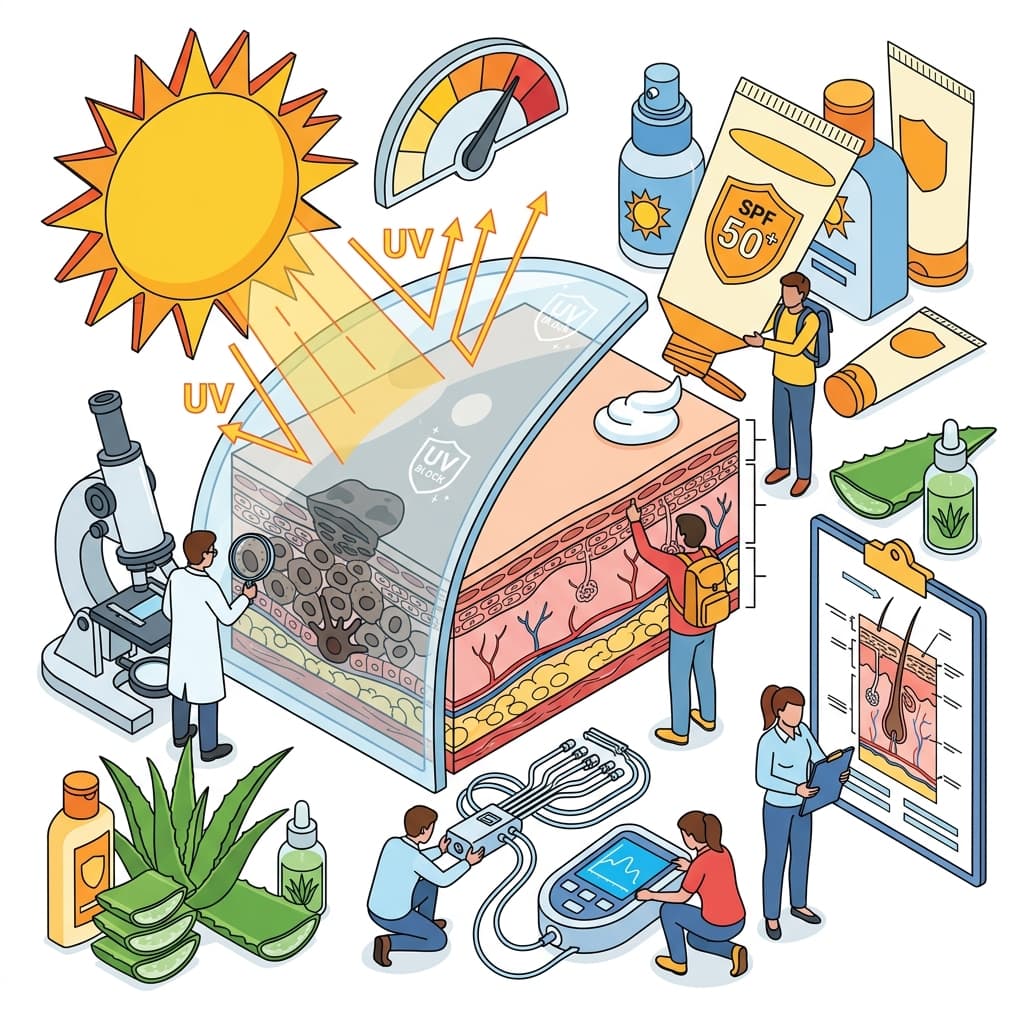
The Science of Summer Sun Protection: Understanding SPF, PA, UVA, UVB, and How to Choose Sunscreen
What's the difference between SPF and PA? How do UVA and UVB affect skin differently? A science-based guide to choosing sunscreen, reapplication timing, and post-sun skincare for summer.
UV Radiation: UVA vs. UVB
Ultraviolet radiation from the sun that reaches the Earth's surface consists of two types:
UVA (320–400nm)
- Skin penetration: Reaches the dermis (deeper layer)
- Effects: Destroys collagen and elastin → wrinkles, sagging, photoaging
- Properties: Penetrates clouds and glass; relatively constant year-round
- Tanning: Triggers melanin production causing delayed tanning
UVB (280–320nm)
- Skin penetration: Reaches the epidermis (surface layer)
- Effects: Causes sunburn; primary driver of DNA damage and skin cancer risk
- Properties: Strongest in summer midday; largely blocked by glass
- Immediate effects: Erythema (redness) appears within hours
UVC (100–280nm)
Nearly entirely absorbed by the ozone layer; does not reach the Earth's surface under normal conditions.
SPF and PA: What the Numbers Mean
SPF (Sun Protection Factor)
SPF measures protection against UVB — specifically, how much longer it takes to cause erythema (redness) compared to unprotected skin.
Example calculation:
- Unprotected skin reddens in 20 minutes
- SPF 50 sunscreen: 20 min × 50 = 1,000 minutes theoretical protection
- Real-world conditions (sweating, friction, swimming) dramatically shorten this
Practical guide:
- SPF 15–20: Daily use, cloudy days
- SPF 30–50: Outdoor activities, sports
- SPF 50+: Extended outdoor exposure, beach, mountains
PA (Protection Grade of UVA)
PA measures UVA protection (a Japanese standard based on Persistent Pigment Darkening):
- PA+: PFA 2–4 (some UVA protection)
- PA++: PFA 4–8 (moderate UVA protection)
- PA+++: PFA 8–16 (high UVA protection)
- PA++++: PFA 16+ (extremely high UVA protection)
Western products use "Broad Spectrum" to indicate meaningful UVA protection.
Heatstroke Risk CheckerEstimate Wet Bulb Globe Temperature (WBGT) and heatstroke risk from temperature and humidity.Choosing the Right Sunscreen
By Activity Level
| Scenario | Recommended |
|---|---|
| Daily commute | SPF 20–30 / PA++ |
| Outdoor errands | SPF 30–50 / PA+++ |
| Sports / outdoor work | SPF 50+ / PA++++ |
| Beach / pool / hiking | SPF 50+ / PA++++ water-resistant |
Chemical vs. Physical Filters
Chemical (UV absorbers): Absorb UV and convert to heat. Lightweight, high SPF achievable. May irritate sensitive skin.
Physical (UV scatterers): Zinc oxide, titanium dioxide — reflect UV physically. Gentler on skin; may leave white cast.
Most modern sunscreens combine both. For sensitive skin or children, mineral (physical) formulas are preferable.
How to Apply Sunscreen Correctly
Amount Matters Enormously
SPF ratings are measured at 2mg/cm² — most people apply 25–50% of this amount, which can reduce effective SPF by more than half.
- Face: 2 fingertip units (~1ml)
- Full body: approximately 30ml (shot glass)
Reapplication Schedule
Reapply every 2–3 hours and immediately after:
- Swimming (even water-resistant formulas need reapplication)
- Heavy sweating
- Towel drying
Application Timing
Apply 30 minutes before sun exposure for chemical filters (allows time for binding to skin); physical filters work immediately.
After-Sun Skincare
Acute Phase (Day of / Day After Sunburn)
- Cool the skin: Damp towel, cool shower — reduce inflammation
- Moisturize: Ceramide/hyaluronic acid products to restore hydration barrier
- Avoid irritants: No scrubs, peels, or alcohol-containing products
- Hydrate internally: Drink plenty of water
Recovery Phase (Days to Weeks After)
- Brightening care: Products with Vitamin C, niacinamide, or arbutin to address hyperpigmentation
- Support natural skin turnover with consistent moisturization
- Melanin deposits from sunburn typically fade over weeks to months
Severe sunburn with blistering, intense pain, or fever requires dermatology consultation (may be equivalent to second-degree burns).
Common Sunscreen Myths
Myth: "I don't need sunscreen on cloudy days" → 60–80% of UV reaches the ground on overcast days. UVA easily penetrates clouds.
Myth: "One application lasts all day" → Sunscreen degrades with sweat, friction, and time. Reapply every 2–3 hours.
Myth: "SPF 100 is twice as good as SPF 50" → SPF 50 blocks ~98% of UVB; SPF 100 blocks ~99%. The difference is marginal, and reapplication matters far more.
Myth: "Sunscreen is only for summer" → UVA exposure is consistent year-round. Daily SPF is the single most evidence-based anti-aging intervention.
Summary
| Item | Key Points |
|---|---|
| UVA | Reaches dermis; photoaging; check PA rating |
| UVB | Causes sunburn, DNA damage; check SPF |
| Amount | Apply generously; most people under-apply |
| Reapplication | Every 2–3 hours; after swimming |
| After-sun | Cool → moisturize → brightening care |
Related Articles