Remote Work Stress Relief: Daily Routines to Maintain Mental Health
Learn how to manage stress and isolation from remote work. Discover how to create work-life separation, self-care routines, and specific strategies to prevent burnout.
The Unexpected Mental Impact of Remote Work
Remote work brought many benefits — no commute, flexible schedules, and more time for family. But years into widespread adoption, a growing number of people are experiencing "feeling like I'm always working," "loneliness from reduced human contact," and "exhaustion that doesn't go away even on days off."
These issues aren't signs of weakness or laziness — they're the result of environmental and psychological stressors unique to remote work environments. This article explains the specific ways remote work affects mental health and introduces practical daily routines to manage stress effectively.
Stress CheckerEvaluate your current mental stress levels with a quick questionnaire.Key Mental Health Impacts of Remote Work
1. Disappearing Work-Life Boundaries
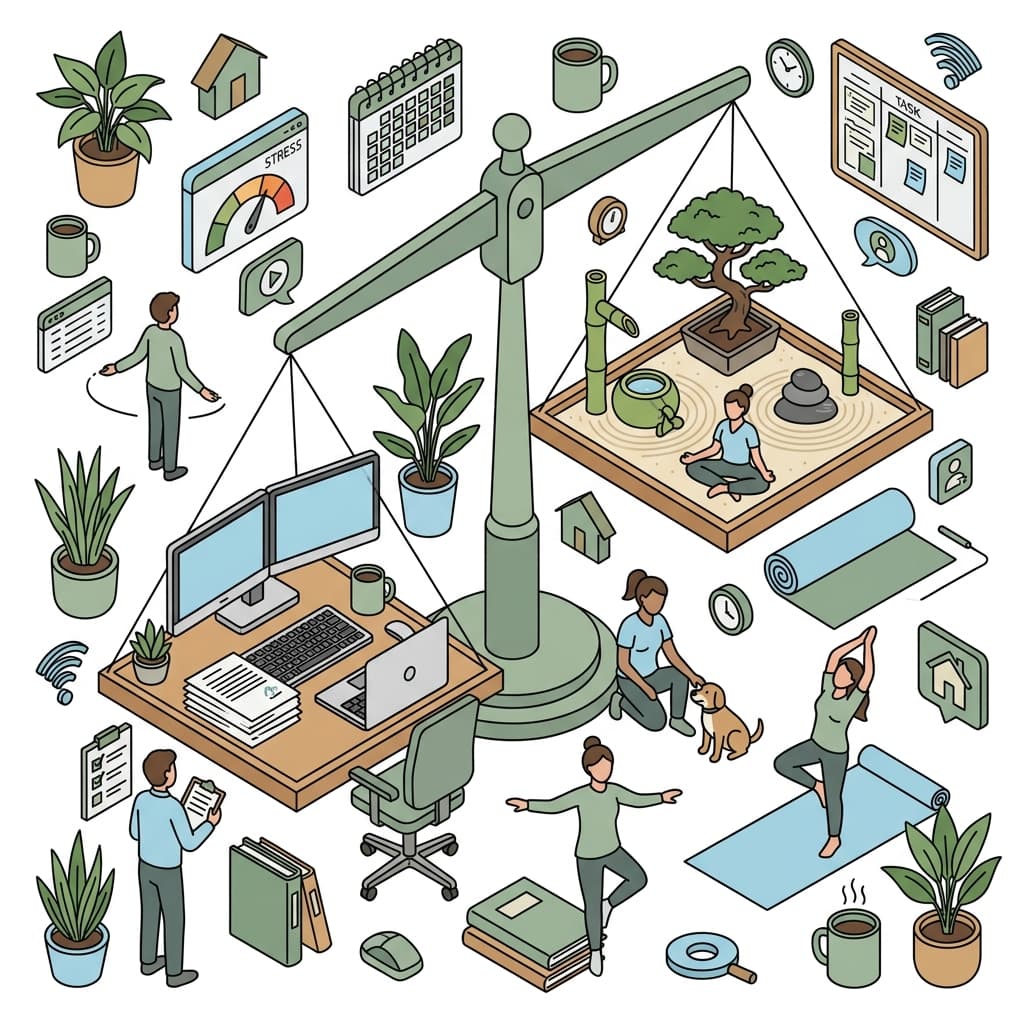
When home becomes office, the "end of work" becomes undefined. Without the physical commute as a mental transition, the brain struggles to switch out of "work mode," leading to chronic tension. Studies show about 60% of remote workers report difficulty separating work from personal life.
2. Loneliness and Lost Connection
Casual office conversations, lunch breaks with colleagues, hallway greetings — these seem trivial but are essential forms of "social contact" for mental health. Remote work drastically reduces them, leading to feelings of isolation and disconnection.
3. Physical Inactivity and Its Mental Effects
Without commuting, daily step counts plummet. Physical inactivity causes stress hormones (cortisol) to accumulate, which compounds psychological stress and contributes to low mood.
4. Burnout Risk
The pressure of "being at home so I should be more productive" or self-imposed pressure without office oversight often leads to overworking. Checking work emails on weekends and working late into the night eventually leads to the sudden exhaustion of burnout — where nothing feels like it's worth doing.
Morning Routines to Protect Your Mental Health While Working Remotely
Change Clothes and Create a "Start Work" Ritual
Not working in pajamas is more important than it sounds. Changing clothes sends a signal to your brain that "work mode is on." Add small consistent rituals — brewing coffee, doing a light stretch — to create a mental on-switch every morning.
5-Minute Morning Walk for Serotonin Release
Walking outside in morning sunlight stimulates "serotonin" release, often called the happiness hormone. Just adding a 5-10 minute outdoor walk to your shower routine can dramatically improve your mood stability for the day.
Limit Your Daily Task List to Three Priorities
Writing out "everything you need to do today" creates an overwhelming list. Setting "just the three most important tasks for today" each morning builds a daily sense of accomplishment.
Mental Care During Work Hours
Use the Pomodoro Technique to Force Rest Breaks
The Pomodoro Technique — 25 minutes of focus followed by a 5-minute break — pairs perfectly with remote work. Without intentional breaks, it's easy to work for hours straight at home.
Pomodoro TimerBoost your focus with a 25-minute Pomodoro timer featuring browser alerts.Create a Visible "End of Work" Signal
Just as office workers feel freed the moment they step outside, remote workers need an "end of workday ritual." Shut down the laptop and move to another room, walk around the block, start cooking dinner — decide on one action that signals "work is done for today."
One "Digital Detox" Day Per Week
If you habitually check work messages on weekends, designate one day completely off. You may feel anxious at first, but you'll likely discover that delayed responses rarely cause problems.
Communication Strategies to Combat Loneliness
Schedule Dedicated Casual Chat Time
Intentionally setting aside time for non-work conversation — virtual coffee breaks, casual video calls — significantly reduces feelings of isolation. Creating team communication norms is essential.
Meet Someone in Person Once a Week
Arrange to meet friends or family in person at least once a week. The warmth of face-to-face interaction fills a gap that text and video calls simply cannot.
Use Co-working Spaces and Cafés Occasionally
If home starts feeling monotonous, working at a co-working space or café a few days a week provides the "ambient stimulation" of being around other people, which maintains motivation and focus.
Burnout Prevention Checklist
Review this checklist weekly. If three or more apply, take action to address your stress levels.
- □ I feel less enthusiastic about work than I used to
- □ I'm tired but can't sleep — or sleeping too much
- □ I get irritated by small things more easily
- □ Activities and hobbies I used to enjoy feel empty
- □ I sometimes feel like "I don't want to do anything"
- □ My concentration doesn't last
Frequently Asked Questions
Q1. Is feeling stressed in remote work a sign of weakness? A: Not at all. Remote work stress is an environmental and structural challenge, not a personal failing. It can be addressed through appropriate environment design and daily habits.
Q2. Are there ways to improve mood without exercising? A: Don't overcomplicate "exercise." A 10-minute walk outside, light stretching, or simply taking the stairs provides meaningful mood improvements without requiring gym visits.
Q3. Should I tell my manager I'm struggling mentally? A: With a supportive manager, it's worth discussing. Awareness of mental health challenges is growing in most workplaces. Employee Assistance Programs (EAPs) and occupational health resources are also worth exploring.
Q4. How do I stop thinking about work on weekends? A: A "worry journal" technique works well — write everything you're concerned about before closing work on Friday. Writing it down signals to your brain that "it's recorded, I can let it go for now."
Summary: Survive Remote Work Through Daily Routines
Maintaining mental health in remote work isn't about doing something dramatic — it's about accumulating small daily routines.
Three things you can start today:
- Create a morning ritual: Use changing clothes and a short walk to switch on "work mode"
- Establish an end-of-work signal: Turn one specific action into the habit that signals "work is over"
- Check your stress level weekly: Catch changes early and respond before they escalate
If mental discomfort persists, consult your doctor or a mental health professional promptly.
Stress CheckerEvaluate your current mental stress levels with a quick questionnaire.